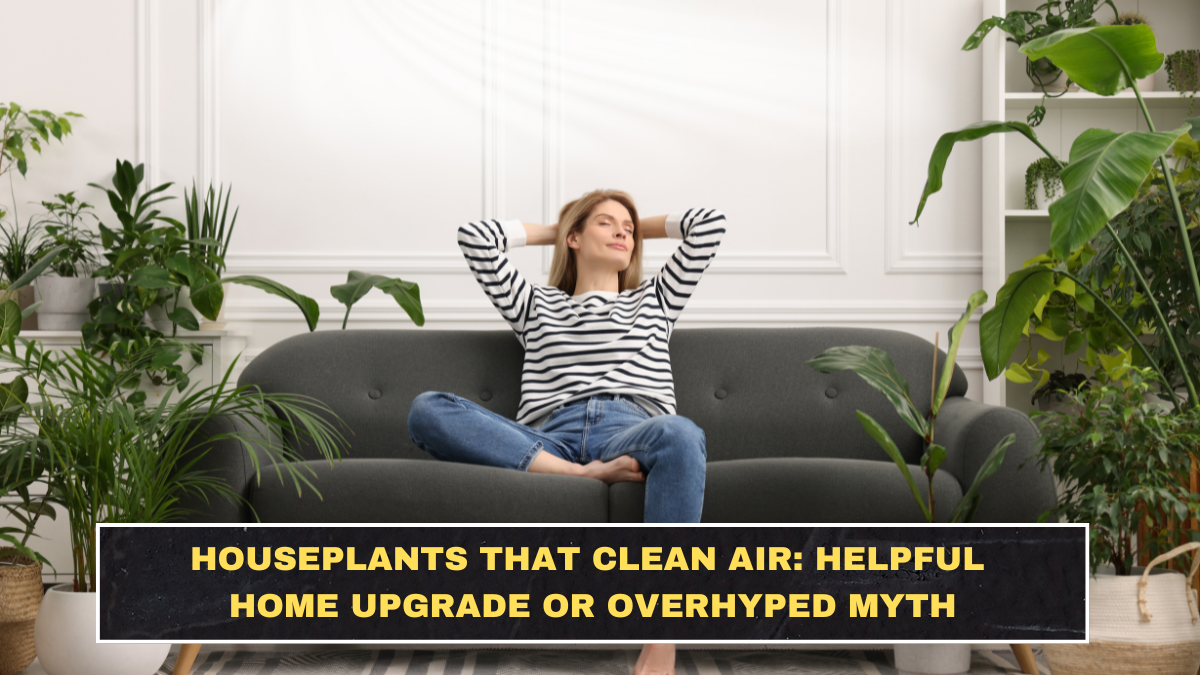
Yes, but not in the way most people imagine. This is where the myth gets inflated. Potted plants can remove some airborne compounds in lab settings, and that part is real. The problem is that the famous “plants clean air” claim was built largely on chamber studies, not on normal homes with open doors, ventilation, airflow, and real-world pollutant loads. A widely cited 2020 review in the Journal of Exposure Science & Environmental Epidemiology concluded that potted plants do not improve indoor air quality in ordinary indoor environments the way people are often led to believe.
Why did this myth become so popular?
Because the original idea is emotionally perfect. It tells people they can buy something beautiful, put it in a corner, and call it a wellness upgrade. That is catnip for marketing. A lot of the hype traces back to older NASA-linked chamber research on plants removing volatile organic compounds. But later reviews have pointed out the obvious problem: lab chambers are not living rooms. Once you move from sealed experiments to real indoor spaces, the effect drops hard. More recent reviews still say plants have pollutant-removal potential, but they also admit the real-world effect of ordinary potted plants falls well short of what the popular myth suggests.
So what do houseplants actually do well?
They make indoor spaces feel better. That is not fake. It is just a different benefit. Plants can improve the look of a room, make spaces feel calmer, and help people feel more connected to the environment around them. They may also have modest local effects on humidity and comfort, depending on the setting. What they are not is a serious substitute for ventilation, source control, or filtration. EPA’s indoor air guidance keeps the focus where it belongs: reduce or remove pollution sources, ventilate with clean outdoor air, and use proper filtration when needed. That is a much less romantic answer, but it is the one that actually helps.
| Claim | Reality |
|---|---|
| Houseplants purify the air in a normal room | Overstated in most real homes |
| Plants remove pollutants in lab studies | True, but lab conditions are not real life |
| Plants make a room feel nicer | Yes, that is one of their strongest real benefits |
| Plants can replace air purifiers or ventilation | No, that is where the myth breaks down |
Are some plants better than others?
Probably, but this is where people get too excited too fast. Some studies and reviews suggest certain species perform better than others at removing specific VOCs under controlled conditions. That means species choice can matter in research terms. But even then, the bigger issue remains scale. A plant that shows pollutant-removal ability in a chamber does not suddenly become a whole-home air-cleaning solution on a windowsill. The more honest reading of the science is that plants have interesting phytoremediation potential, especially in engineered or botanical biofilter systems, not that a few houseplants can do the job of real air-cleaning equipment in a normal apartment.
What actually improves indoor air more than plants?
Source control, ventilation, and filtration. That is the part people skip because it is less aesthetic. If indoor air is a real concern, EPA guidance points to controlling the source of pollution first, bringing in cleaner outdoor air when possible, and using portable air cleaners or HVAC filters appropriately. EPA’s guide on air cleaners says portable air cleaners and HVAC filters can reduce indoor air pollution, especially particles, though they are not a total solution either. That makes them far more practical for actual air-quality improvement than relying on decorative plants alone.
Does that mean houseplants are pointless?
No. It just means people should stop assigning them jobs they are not built to do. Houseplants can still be a smart home upgrade if you like them, enjoy caring for them, or want a room to feel less sterile. They can contribute to comfort, mood, and visual softness. That is enough. The problem begins when “plants are nice to have” gets turned into “plants are a serious air purification strategy.” That leap is where the myth outruns the science.
What is the smartest way to think about air-purifying plant claims?
Treat them like a half-truth that marketing stretched too far. Plants are not useless. They are just not tiny green HEPA filters. If you want healthier indoor air, focus first on what is generating pollutants, how the space is ventilated, and whether filtration is needed. If you also want plants because they make the room feel better, great. Just do not confuse mood improvement with serious air cleaning. That is the difference between liking plants and falling for plant theater.
FAQs
Did the NASA plant study prove houseplants clean air?
It showed plants could remove some pollutants in sealed experimental settings. It did not prove that a few houseplants meaningfully clean the air in ordinary homes.
Do houseplants improve indoor air quality in real homes?
Not in the dramatic way the myth suggests. A major review concluded that potted plants do not improve indoor air quality in real indoor environments the way popular claims imply.
Are houseplants still worth having indoors?
Yes, if you like them. They can improve the feel of a room and make a space more pleasant, even if they are not a serious air-cleaning solution.
What works better than plants for indoor air?
EPA guidance points to source control, ventilation, and properly used air cleaners or HVAC filtration as more practical ways to improve indoor air.