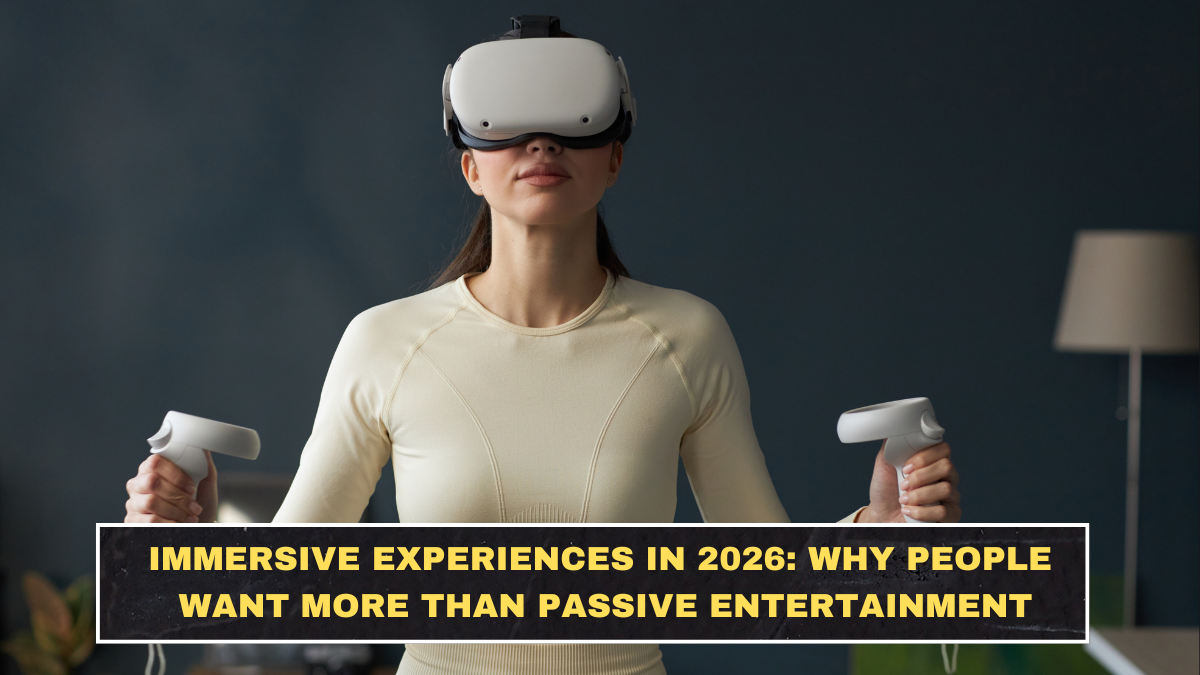
Immersive experiences are growing in 2026 because consumers increasingly want participation, not just observation. That shift is no longer vague lifestyle talk. In India, an EY-Parthenon and BookMyShow report said 78% of consumers prefer spending on experiences over products, and Eventbrite’s 2025 trend report said 65% of consumers are looking for transformative experiences. Those numbers matter because they show the same pattern from two different angles: people are spending for memory, emotion, and social connection, not just ownership.
This trend is not only about entertainment for entertainment’s sake. It is also about what passive content no longer gives people. Streaming, scrolling, and background watching are easy, but they are also forgettable. Deloitte’s 2026 media and entertainment outlook notes that traditional media still defines quality through strong narratives and immersive worlds, while EY says the “experiences economy” is becoming a strategic necessity rather than a side opportunity. In plain terms, companies now understand that if audiences can get endless passive content at home, live and experiential formats must offer something harder to replace.
Why are immersive experiences rising now?
The short answer is that people are tired of flat consumption. The longer answer is that immersive experiences combine identity, community, and memory in a way ordinary products often cannot. Vogue’s recent reporting on the superfan economy shows how emotional connection and belonging are driving spending on experiences, while EY’s India events report says experience-led consumption is reshaping how brands build loyalty and relevance. That is why immersive experiences are rising across fan events, themed attractions, branded activations, and interactive live shows.
There is also a business reason. Brands and operators are following the money. Fortune Business Insights estimates the immersive marketing market at $11.66 billion in 2026, after valuing it at $9.03 billion in 2025. Even if private market forecasts should always be treated cautiously, the direction is obvious: more money is moving into immersive formats because companies think participation drives stronger engagement than passive exposure.
Which immersive formats are actually working?
The formats working best are the ones with a clear reason to exist. Live events, fandom-driven experiences, interactive themed environments, and branded experiences with social value are doing far better than generic “walk-through content.” EY’s India live-events report describes a ₹13,000 crore market fueled by experiential marketing, and the Themed Entertainment Association keeps highlighting unconventional, experience-first projects as signals of where the sector is evolving.
That matters because not every immersive idea is strong. A projection wall and some sound effects do not automatically create value. The formats that survive tend to offer one or more of three things: emotional payoff, shareable identity, or active participation. Eventbrite’s trend report found consumers are hungry for transformative experiences, which helps explain why passive installations often fade while interactive formats spread faster.
Which parts of the trend are strongest?
| Format | Why it works | What makes it weak |
|---|---|---|
| Fan and community events | Creates identity and belonging | Feels fake if the brand forces it |
| Live branded experiences | Gives people a reason to show up physically | Fails when it is just marketing wrapped as fun |
| Themed entertainment | Builds immersive worlds people remember | Expensive if repeat value is weak |
| Transformative or skills-based events | Feels more meaningful than passive viewing | Can become gimmicky if outcomes are shallow |
This is the core filter people keep missing. Immersive experiences work when they make the audience feel involved. They flop when they are just expensive decoration pretending to be culture.
Are people really choosing experiences over products?
In many cases, yes. EY’s India data is explicit, and broader experience-economy reporting points the same way. MoneyWeek recently described the global leisure and travel boom as part of a wider experience economy expected to exceed $12 trillion by 2035, while Barron’s reported on China’s growing “emotional economy,” which includes lifestyle and immersive spending tied to attachment and identity. Different regions, same direction: people are increasingly paying for experiences that feel personal, memorable, or socially meaningful.
But this is where lazy interpretation starts. “Experiences over things” does not mean consumers suddenly became profound. It often just means they want better stories, better memories, and better reasons to spend. That is still commercially powerful, but it is not automatically deep. Plenty of immersive formats still fail because they confuse spectacle with meaning. EY’s 2026 trend piece makes the same point indirectly by stressing simplicity, authenticity, and experience as strategic drivers, not just visual novelty.
What does this mean for brands and entertainment companies?
It means passive attention is weaker than it used to be. If a brand or entertainment company wants people to leave the house, buy a ticket, post about it, and remember it, the experience has to feel distinct. EY says the experiences economy is moving from adjacent opportunity to strategic necessity, and Deloitte’s outlook reinforces the value of immersive worlds and high-engagement storytelling. The implication is straightforward: immersive experiences are rising because they are one of the few ways to compete with endless digital distraction.
The businesses most likely to win are not the ones shouting “immersive” the loudest. They are the ones building formats people actually want to repeat, recommend, and identify with. That is why fandom, themed entertainment, and live experience ecosystems are stronger than one-off gimmick installs.
Conclusion?
Immersive experiences in 2026 are rising because passive entertainment is too easy and too forgettable. Consumers want events, environments, and moments that feel social, memorable, and emotionally worth paying for. Multiple current sources point in the same direction: experience-led spending is growing, and brands are following it fast.
The honest answer, though, is that immersive experiences are not winning because they are automatically better. They are winning because the good ones give people something passive media often cannot: involvement. That is the real advantage. And when that involvement is fake, shallow, or overdesigned, the whole thing collapses into overpriced hype.
FAQs
Are immersive experiences really growing in 2026?
Yes. Current reporting and industry data show rising consumer preference for experience-led spending, including EY’s finding that 78% of Indian consumers prefer experiences over products and Eventbrite’s finding that 65% of consumers want transformative experiences.
What kinds of immersive experiences are working best?
Formats built around community, participation, fandom, and clear emotional payoff are performing best. Themed entertainment, live branded events, and fan-driven experiences are stronger than generic visual installations.
Why are brands investing more in immersive experiences?
Because passive media is easier to ignore. Immersive formats can create stronger engagement, loyalty, and memory, which is why EY describes the experiences economy as a strategic necessity.
Are immersive experiences always worth the hype?
No. They only work when people feel genuinely involved. When the experience is shallow or purely decorative, it quickly becomes expensive hype instead of meaningful entertainment.
Click here to know more