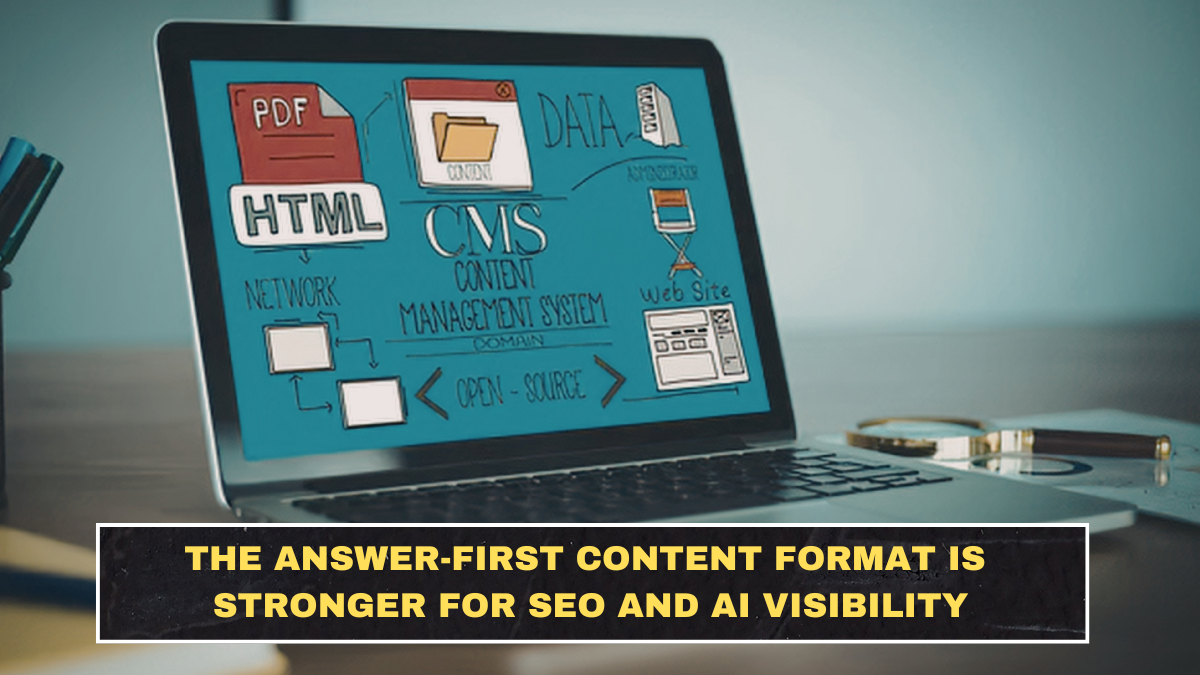
Most articles still waste the first few paragraphs. They tease, delay, and circle around the point instead of answering the query. That is weak writing, and it is also bad strategy. Google’s people-first guidance says content should help users, satisfy their needs, and avoid being created mainly to chase rankings. Google’s featured snippets documentation also explains that featured snippets show the descriptive answer first, which makes direct answers especially useful for this kind of visibility.
The answer-first format is simple: give the direct answer early, then expand with explanation, evidence, examples, and related questions. That structure works better because readers get clarity quickly, while search systems and AI features can more easily understand what the page is actually about. Google’s guidance for AI features says site owners should focus on unique, satisfying content for users, and its 2025 Search Central advice says AI search experiences are surfacing longer, more specific questions and follow-up questions.
What answer-first content actually means
Answer-first does not mean writing thin content. It means the page starts with the clearest useful response instead of making the reader work for it. After that, the rest of the article should deepen the answer, not repeat it in weaker words. This is especially useful for:
- question-based searches
- comparison articles
- how-to content
- “why” and “what” explainers
- pages targeting AI summaries and snippets
The reason this matters is obvious: users do not search because they want suspense. They search because they want resolution.
Why this format works better now
Google’s Search Central documentation says people-first content should leave visitors feeling they had a satisfying experience, not a frustrating one built for search engines first. In AI-driven search, that matters even more because pages are increasingly evaluated for whether they directly fulfill the query. Google’s AI features documentation also says the same core guidance applies to AI Overviews and AI Mode.
Featured snippets are another reason. Google says featured snippets reverse the normal search-result format by showing the descriptive snippet first. That does not mean there is a special “snippet formula,” but it does mean a page that answers early is easier for Google to interpret for direct-answer surfaces.
How the structure should look
| Section | What it should do |
|---|---|
| Opening answer | Give the direct response in 2–4 sentences |
| Context section | Explain why the answer matters |
| Breakdown section | Add examples, steps, data, or comparisons |
| Clarification section | Handle exceptions, limits, or nuance |
| FAQs | Answer related follow-up questions clearly |
This structure is stronger than the old SEO habit of stuffing intros with vague background. Google’s 2025 guidance for succeeding in AI search says to focus on unique, non-commodity content that visitors find helpful and satisfying. That means the page must become useful early, not eventually.
What most publishers get wrong
The biggest mistake is writing introductions like a school essay. They begin with generic history, broad definitions, or padded context before answering the actual question. That is exactly the kind of search-engine-first behavior Google warns against when content is made primarily to gain rankings rather than help users.
Another mistake is confusing answer-first with “just write a paragraph and stop.” That is lazy. A strong answer-first article still needs depth, proof, examples, and clean structure. The direct answer earns attention; the supporting content earns trust.
A better approach is:
- answer the main question early
- use clear H3 sections for the expansion
- include one table when comparison helps
- add follow-up questions users actually ask
- avoid filler intros and keyword padding
Where this format helps most
Answer-first formatting is especially useful for pages targeting:
- featured snippets
- People Also Ask style questions
- AI answer surfaces
- mobile readers with low patience
- informational queries with clear intent
Google’s structured-data documentation for FAQPage and QAPage also shows that question-and-answer formats can help Google better understand page structure when used appropriately, though Google does not guarantee rich results. That matters because clearer structure helps both machines and users, even when no special result is shown.
Conclusion
The answer-first content format is stronger because it respects how people actually search. Users want the answer early, not after five paragraphs of throat-clearing. Google’s own guidance keeps pointing in the same direction: create people-first, satisfying, clearly structured content that fulfills the need quickly. Pages that answer first and expand intelligently are usually better for readers, better for snippets, and better positioned for AI-driven visibility.
FAQs
1. Does answer-first content mean the article should be very short?
No. It means the answer comes early. The rest of the article should still add evidence, explanation, examples, and nuance.
2. Is answer-first content good for featured snippets?
Often yes, because Google says featured snippets show the descriptive answer first, so pages with direct early answers are easier to use for that kind of result.
3. Does this help with AI Overviews too?
It can, because Google says the same core guidance applies to AI features and recommends unique, helpful, satisfying content for users.
4. What is the biggest mistake in this format?
Giving the answer too late. If the page hides the main response behind filler, it weakens the reader experience and often weakens SEO value too.