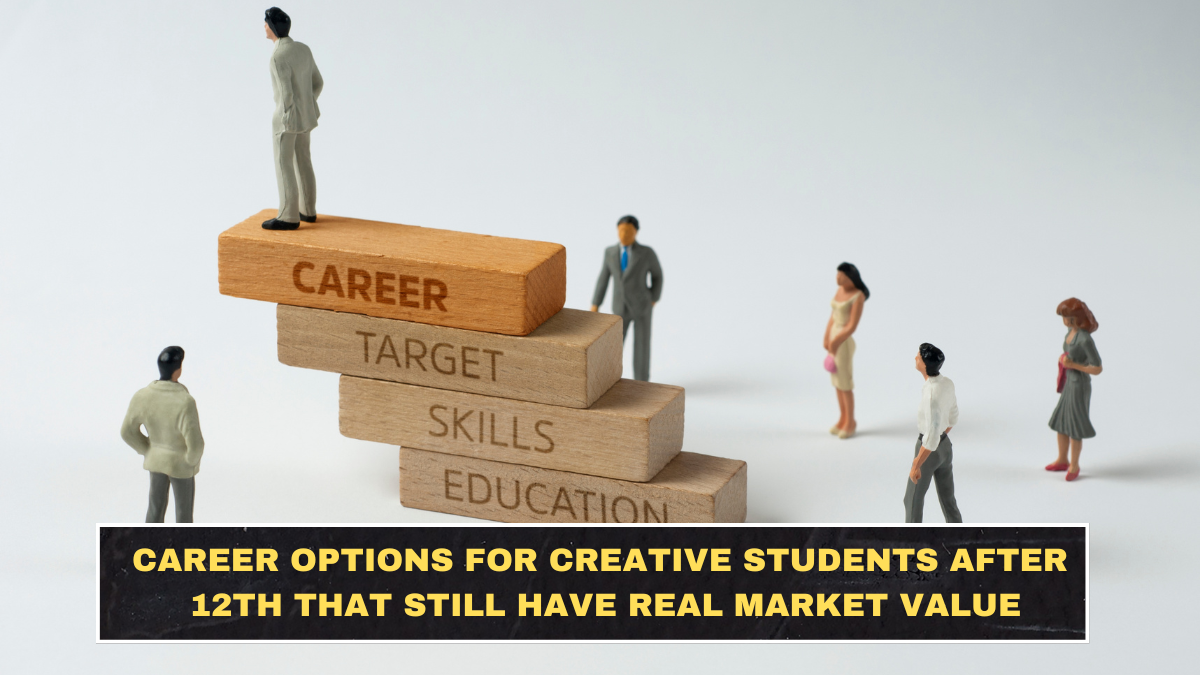
Creative students usually get one of two bad speeches after 12th. Either they are told to “just follow passion,” which is vague and useless, or they are told creativity has no stable future, which is equally lazy. The truth is harsher and simpler: creative careers can have real market value, but only when creativity is tied to business demand, digital tools, and proof of work. The World Economic Forum says creative thinking remains one of the top skills increasing in importance by 2030, and it also flags design and user experience as a growing skill area.
That matters in India because the market around digital content, media, retail media, and product experiences is still expanding. IBEF says India’s media and entertainment industry is expected to grow around 9.7% annually to reach about US$ 73.6 billion by FY27, while e-commerce platforms’ advertising revenues crossed Rs. 15,000 crore in FY25, showing strong demand for content, design, branding, and performance-led creative work.
What creative students usually get wrong
The biggest mistake is thinking creativity alone is enough. It is not. The market pays for useful creativity, not self-expression without results. The second mistake is choosing a broad degree and building no portfolio, no tool skills, and no specialization. LinkedIn’s 2026 labor-market reporting explicitly says organizations need both AI literacy and people skills such as design thinking and adaptability. That means creative students need human originality plus digital fluency, not one without the other.
Creative careers after 12th that still have market value
| Career path | Why it has market value | Good route after 12th |
|---|---|---|
| UI/UX design | Digital products still need usable interfaces | BDes, design, psychology + UX tools |
| Graphic and brand design | Businesses still need visual identity and campaigns | Design degree, portfolio, Adobe/Figma tools |
| Video editing and motion graphics | Content-led brands and creators need constant production | Media, editing tools, strong reel portfolio |
| Animation and visual storytelling | Media, ads, explainers, gaming, and branded content need it | Animation, design, VFX-related learning |
| Content strategy and copywriting | Brands need messaging, not just visuals | BA, media, marketing + portfolio |
| Social media content production | Short-form content and brand storytelling keep growing | Any degree + editing, scripting, content skills |
| Product content / UX writing | Apps and SaaS products need clear user-facing language | English, communication, UX/content tools |
| Performance creative for ads | E-commerce and digital ads need creatives tied to revenue | Marketing + design/video + analytics |
The strongest options right now
UI/UX design is one of the smartest routes because it sits between creativity and digital business. It is not just art. It is product thinking, user behavior, structure, and clarity. WEF’s 2025 outlook specifically identifies design and user experience as a skill area expected to increase in use, which is a stronger signal than random internet hype.
Brand design, video editing, and performance creative also look practical because advertising money is still moving online. IBEF reported that digital media accounted for roughly 46% of India’s advertising market, and e-commerce ad revenues rose sharply in FY25. That means businesses still need creatives who can make visuals, videos, and campaigns that actually drive clicks, attention, and sales.
Careers students should stop romanticizing
Not every creative label has equal market value. Saying “I want to work in media” means nothing if you cannot edit, design, write, animate, or build campaigns. The brutal truth is that many creative students stay broke because they hide behind taste instead of building output. A weak degree plus no portfolio is dead weight. A decent degree plus strong proof of work is far more useful.
Students should build around these practical skill clusters:
- design tools and visual systems
- writing and messaging
- editing and motion
- user understanding and product thinking
- AI-assisted workflows without losing human judgment
Best courses after 12th for creative students
The strongest route depends on the type of creativity. Design students often do well with BDes, visual communication, animation, or interaction-design paths. Students stronger in writing and communication can move through BA, journalism, media, or marketing routes, but only if they add portfolio work. Students interested in digital products should look seriously at UX, product content, and design systems. The degree matters less than whether it helps build marketable output.
Conclusion
Creative students after 12th absolutely have real career options, but not by relying on vague passion-talk. The strongest paths right now are UI/UX design, brand and graphic design, video editing, animation, content strategy, social media content production, UX writing, and performance creative. These careers have market value because they connect creativity with digital products, advertising, e-commerce, and user attention, all of which are still growing in India.
The real mistake is not choosing a creative career. The real mistake is choosing one without building proof that your creativity is useful to somebody who will actually pay for it.
FAQs
Which creative career after 12th has the best future scope?
UI/UX design, video editing, performance creative, brand design, and content strategy currently have some of the strongest practical value because they connect directly to digital products, ad spend, and business growth.
Is animation still a good career after 12th?
It can be, especially for students who build strong storytelling and production skills. It works better when paired with real software ability and a portfolio, not just a course certificate.
Do creative students need AI skills now?
Yes. LinkedIn’s 2026 reporting says AI literacy and people skills need to grow together. Creative students who ignore AI tools completely will fall behind.
Is a portfolio more important than the degree?
In many creative careers, yes. A degree can help, but the portfolio is often the real proof that you can do useful work.