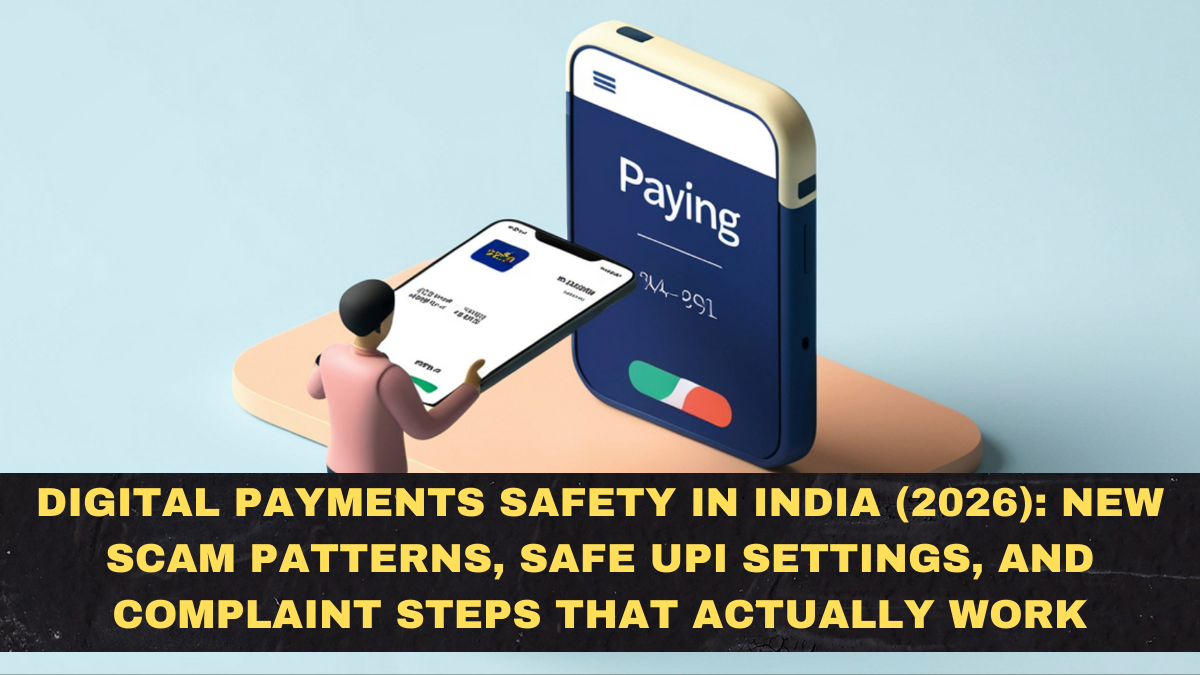
Digital payments safety in India in 2026 is no longer just a tech problem. It has become a mass-risk problem affecting salaried employees, students, retirees, shopkeepers, and even digitally cautious users. UPI, mobile banking, and card payments are now so deeply embedded into daily life that most people no longer pause to verify requests, links, QR codes, or caller identities. That behavioral shift, not weak technology, is what scammers are exploiting at scale.
What makes the current situation more dangerous than earlier years is that scams are no longer crude. Fraudsters now use real merchant names, fake customer-care numbers, cloned banking apps, and psychologically timed messages that create urgency or fear. Most victims are not careless. They are rushed, distracted, or misled by messages that look perfectly legitimate. Digital payments are technically safer than ever, but human decision-making has become the weakest security layer.
This guide explains the dominant scam patterns in India in 2026, the UPI and banking settings that actually reduce risk, what to do the moment money is debited wrongly, how the complaint escalation system truly works, and which habits quietly protect you far better than any antivirus app or OTP warning.
Digital Payments Safety in India 2026: Important Information at a Glance
Before getting into scam mechanics and protection strategy, here is a clean operational snapshot of what actually matters for ordinary users trying to stay financially safe.
| Item | What You Should Know | Why It Matters |
|---|---|---|
| Primary Risk Channel | UPI-based social engineering | Largest fraud volume |
| Most Common Trap | Fake refund and customer-care calls | High success rate |
| Weakest Security Layer | Human urgency and trust | Bypasses all tech protections |
| Fastest Damage Window | First 30 minutes after debit | Recovery probability highest |
| Best Protection Method | Behavioral discipline + app settings | More effective than apps |
| Final Escalation Body | Bank + NPCI + RBI | Complaint resolution path |
Why Digital Payment Fraud Has Exploded in India
The explosion in fraud is not because UPI or banking apps are insecure. It is because transaction friction has become too low. Money now moves instantly, reversals are slow, and verification steps are mentally automated by users who make dozens of daily payments.
Scammers exploit three predictable emotions: urgency, fear, and greed. Messages like “your KYC will be blocked,” “refund pending,” or “account under review” trigger panic responses that bypass rational thinking. Once a user authorizes a payment or shares an OTP, the system treats it as a legitimate instruction.
This is not a software problem. It is a behavioral vulnerability problem.
The Most Common Scam Patterns in 2026
The dominant fraud formats are no longer limited to unknown callers. Fake delivery refund calls, fake bank KYC updates, fake customer-care numbers listed on search engines, QR-code refund traps, and cloned payment app screens now form the bulk of reported cases.
In most of these scams, victims are tricked into approving a “refund” request that is actually a debit authorization. Others are guided to install fake apps that mirror real banking interfaces and capture login credentials invisibly.
The unifying factor is that victims believe they are solving a problem, not creating one.
Why OTP Warnings and App Alerts Are Not Enough
Every banking app now flashes warnings saying “never share OTP” and “bank will never call you.” These warnings do not fail technically. They fail psychologically.
In a panic situation, the brain prioritizes resolution speed over security logic. Users assume that exceptions exist. They assume banks make mistakes. They assume customer-care rules change.
No warning can override panic unless habits are trained in advance.
UPI and Banking Settings That Actually Reduce Risk
Most users never touch security settings after installing a payment app. That is a mistake.
You should enable low daily transaction limits, app-level PIN retries lockouts, biometric confirmation where available, and SMS/email alerts for every debit. You should disable “collect request auto-approval” features entirely.
These settings do not prevent scams. They slow down damage and create pause windows where you can detect fraud before large losses accumulate.
What To Do Immediately If Money Is Debited Wrongly
The first 30 minutes after fraud are the only meaningful recovery window. After that, money is usually layered through multiple accounts.
You must immediately block your UPI ID or card, call your bank’s fraud helpline, register a dispute inside the app, and file a complaint through the national cybercrime portal. Delay kills recovery probability.
Do not waste time arguing with scammers or collecting screenshots first.
How the Complaint Escalation System Actually Works
Most victims think filing one complaint is enough. It is not.
You must raise complaints with three entities: your bank, NPCI (for UPI cases), and the cybercrime reporting system. If unresolved, you escalate to the RBI banking ombudsman.
Banks move slowly unless regulatory pressure exists.
Documentation discipline decides outcomes more than emotional appeals.
Why Most Victims Never Get Their Money Back
Money recovery fails mainly because users authorize transactions themselves under deception. Legally, that counts as user consent.
Banks refund only when technical failures occur, not behavioral mistakes.
This is brutal but true.
The Only Habits That Actually Protect You
Never approve “refund” collect requests.
Never search customer-care numbers on Google.
Never install APK files for banking or payments.
Never act under urgency without pausing 60 seconds.
These four habits prevent more fraud than any software update.
Conclusion
Digital payments safety in India in 2026 is about behavior, not technology. UPI is not unsafe. People under pressure are unsafe.
If you slow down, set limits, and escalate fast, your risk drops dramatically. Most fraud is preventable. Most victims simply act too fast.
FAQs
What is the most common digital payment scam in India?
Fake refund and fake customer-care scams.
Can banks reverse UPI fraud transactions?
Rarely, unless technical failure occurred.
What is the fastest action after fraud?
Block account and call bank immediately.
Are OTP warnings enough to stop scams?
No. Behavioral habits matter more.
Is UPI unsafe in 2026?
No. Human error causes most losses.
Click here to know more.