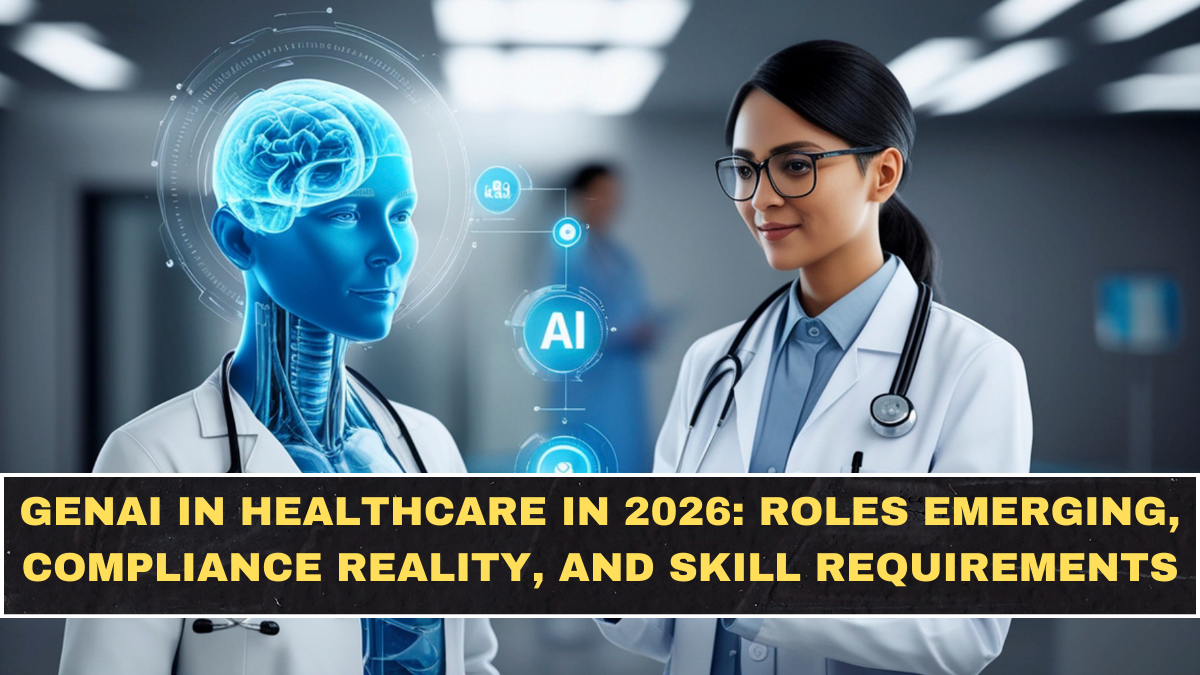
GenAI in healthcare in 2026 is expanding carefully, not explosively. Unlike consumer tech, healthcare cannot afford experimentation without safeguards. Decisions affect patient safety, clinical outcomes, and legal accountability. This reality has shaped how GenAI is deployed and, as a result, what kinds of jobs are actually being created across hospitals, diagnostics firms, healthtech companies, and insurers.
In India, healthcare AI adoption is driven by scale pressure, clinician workload, and data fragmentation rather than novelty. GenAI is used to assist, summarize, and prioritize, not to replace doctors. Understanding the real compliance constraints and role expectations helps professionals avoid unrealistic assumptions about healthcare GenAI careers in 2026.
Why Healthcare GenAI Adoption Is Slower but More Durable
Healthcare adoption is slower because errors carry serious consequences. Clinical decisions must be explainable, auditable, and defensible.
This forces organizations to deploy GenAI in support roles rather than decision-making roles. Tools are designed to assist clinicians, not override them.
In 2026, slower adoption has produced more stable and sustainable job roles.
Core GenAI Use Cases in Healthcare Today
Clinical documentation is a major use case. GenAI assists with summarizing patient notes, discharge summaries, and reports.
Another area is triage support, where AI helps prioritize cases based on risk signals. Administrative automation reduces clinician burnout.
These use cases shape the hiring demand across healthcare AI teams.
New Roles Emerging in Healthcare GenAI Teams
New roles include clinical AI analysts, model validation specialists, healthcare data governance leads, and AI product owners.
These roles sit close to clinical workflows and compliance teams. They focus on quality, safety, and usability rather than raw model performance.
In India, hybrid roles combining healthcare domain knowledge with AI literacy are growing fastest.
Compliance and Regulatory Reality in Healthcare AI
Compliance defines healthcare GenAI. Data privacy, consent, audit trails, and model explainability are non-negotiable.
AI systems must support human oversight and escalation. Black-box automation is rarely acceptable.
In 2026, compliance knowledge is a core career skill, not a legal afterthought.
Skills That Matter for Healthcare GenAI Roles
Domain understanding is critical. Professionals must understand clinical workflows, terminology, and decision contexts.
AI literacy matters, but deep model training skills are not always required. Understanding evaluation, bias, and failure modes is essential.
Communication skills are crucial because outputs must be trusted by clinicians.
Technical Versus Clinical Backgrounds
Healthcare GenAI teams are interdisciplinary. Engineers, clinicians, analysts, and compliance professionals collaborate closely.
Clinicians transitioning into AI roles bring credibility and context. Technical professionals must learn healthcare constraints.
In India, cross-domain profiles are especially valuable due to workforce shortages.
Data Challenges Unique to Healthcare
Healthcare data is messy, incomplete, and inconsistent. GenAI systems must handle missing context and varied formats.
Data quality and lineage are ongoing challenges. Poor data can produce dangerous outputs.
In 2026, data governance skills are central to healthcare AI success.
Ethics and Patient Trust in GenAI Systems
Patient trust underpins healthcare. GenAI systems must respect consent, privacy, and dignity.
Ethical review is embedded into deployment decisions. Transparency matters as much as accuracy.
Healthcare GenAI careers reward professionals who protect trust while enabling efficiency.
How to Enter Healthcare GenAI Roles
Entry paths vary. Healthcare professionals can upskill in analytics and AI literacy. Technologists must learn clinical context.
Participating in healthtech projects or hospital digitization initiatives builds relevance. Exposure matters more than labels.
In 2026, credible entry paths are gradual and evidence-based.
Common Misconceptions About Healthcare AI Careers
A common misconception is that AI replaces doctors. In reality, AI supports clinicians under supervision.
Another misconception is that healthcare AI jobs are purely technical. Many roles focus on governance and workflow design.
Understanding these realities prevents career misalignment.
How Hiring Teams Evaluate Healthcare GenAI Candidates
Hiring teams test risk awareness and judgment. They ask how candidates would handle errors or uncertainty.
Clear explanation of safeguards and escalation paths matters. Overconfidence is a red flag.
In 2026, maturity and responsibility drive hiring decisions.
Conclusion: Healthcare GenAI Careers Demand Responsibility First
GenAI in healthcare in 2026 creates meaningful careers focused on safety, quality, and support rather than disruption for its own sake. Roles exist where professionals help clinicians work better while protecting patients and institutions.
For candidates, success lies in respecting compliance realities, building domain understanding, and demonstrating careful judgment. Those who approach healthcare GenAI with humility and responsibility will find stable, impactful opportunities as adoption continues to scale thoughtfully.
FAQs
Are GenAI healthcare jobs mostly technical?
No. Many roles focus on clinical support, governance, and workflow integration.
Do clinicians need coding skills to work in AI roles?
No. AI literacy and domain expertise matter more than coding.
Is healthcare AI heavily regulated in India?
Yes. Data privacy, consent, and auditability are critical requirements.
Can freshers enter healthcare GenAI roles?
It is possible, but domain understanding and strong fundamentals are essential.
Does GenAI replace doctors or nurses?
No. It supports them while humans remain accountable.
Which organizations hire for healthcare GenAI roles?
Hospitals, diagnostics firms, healthtech companies, and insurers are key employers.