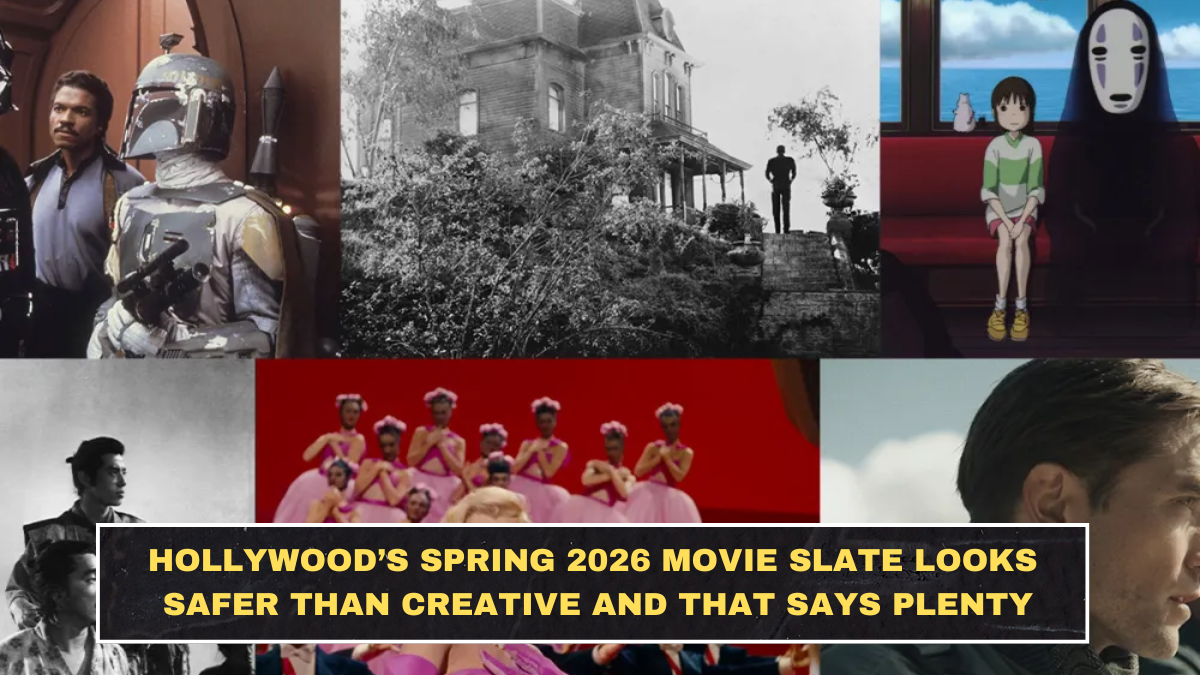
Hollywood’s spring 2026 slate looks commercially smart and creatively cautious. The box office has improved, with North American revenue up about 25% year over year heading into April, but the titles carrying the most momentum are mostly franchise, sequel, or brand-extension plays rather than bold original bets. Barron’s reported that The Super Mario Galaxy Movie was tracking for a $160 million to $200 million five-day domestic opening, while Project Hail Mary had already crossed $300 million worldwide. That tells you the market is alive, but it also tells you what studios trust most right now: familiar brands and proven audience behavior.

What the spring slate is really saying
The pattern is not subtle. April and the months right after it are being framed by titles such as The Super Mario Galaxy Movie, then bigger summer-facing tentpoles like The Odyssey, Spider-Man: Brand New Day, and Avengers: Doomsday. Barron’s explicitly pointed to those films as the kind of giant releases expected to define 2026’s commercial conversation. Variety and Rotten Tomatoes also highlighted the same broad pattern in their 2026 most-anticipated lists: big franchise IP, major sequels, and branded event movies dominate the year’s center of gravity.
Why studios are playing it this safe
Because the economics reward caution. Reuters reported in 2025 that U.S. and Canadian box office receipts were still about 25% below 2019’s pre-pandemic level even after recovery progress, which means studios are still operating in a business that has not fully rebuilt theatrical certainty. In that environment, executives are far more likely to back films with pre-sold awareness than to gamble on riskier original concepts. A Mario sequel is easier to market than an untested mid-budget drama, and a Marvel or Spider-Man film travels globally with less friction than a stranger idea does.
The strongest proof point is Mario
If you want the cleanest example of Hollywood’s logic, it is Mario. Barron’s said Universal expected The Super Mario Galaxy Movie to dominate April and potentially become one of 2026’s biggest hits. The original 2023 film grossed $1.36 billion globally, which makes the sequel a classic studio comfort zone move: family-friendly, global, merch-friendly, and built on one of the most recognizable entertainment brands on earth. That is not creative bravery. That is industrial pattern recognition.
The exception proves the rule
The most useful counterexample is Project Hail Mary. AP reported it had reached $300.8 million worldwide in its second weekend and had become the biggest hit of 2026 so far. That matters because it shows audiences will still show up for a non-franchise film when the package is strong enough. But even that exception is not pure creative risk: it is based on a bestselling Andy Weir novel, stars Ryan Gosling, and comes with premium-format scale. So even one of the year’s standout “original-feeling” successes is still anchored by recognizable IP and star power.
What the numbers and titles suggest
| Signal | Current evidence | What it suggests |
|---|---|---|
| Box office rebound | North American revenue up about 25% year over year | The market is healthier, but still selective |
| April anchor title | Super Mario Galaxy Movie tracking for $160M–$200M five-day debut | Studios trust sequels with built-in demand |
| Breakout non-franchise-ish hit | Project Hail Mary at $300.8M worldwide | Audiences still respond to scale and stars, but not blindly to originality alone |
| Summer-facing tentpoles | The Odyssey, Spider-Man: Brand New Day, Avengers: Doomsday | The rest of 2026 is still being sold on giant IP confidence |
Why this matters beyond box office nerd talk
Because the slate tells you how Hollywood currently reads risk. When studios feel confident, they talk about originality. When they feel exposed, they reach for the safest possible version of spectacle. Spring 2026 looks like the second situation. Even the heavily promoted films are built around nostalgia, franchise extension, famous characters, or well-known source material. That does not mean the movies will be bad. It means the industry is still behaving defensively. This is an inference from the current release mix and the commercial framing around the biggest titles.
What to watch next
The useful indicators are simple:
- whether Mario actually opens near the top of tracking, because that will reinforce sequel-first thinking even more strongly
- whether Project Hail Mary keeps holding, because that would strengthen the case for fewer purely franchise-dependent bets
- whether summer marketing for Spider-Man, The Odyssey, and Avengers: Doomsday keeps drowning out smaller films, because that will tell you how narrow the studio focus still is
Conclusion
Hollywood’s spring 2026 movie slate looks safer than creative because the business still trusts what audiences already know. Theaters are recovering, but the recovery is being led by sequels, major brands, and giant recognizable titles rather than a wave of bold original filmmaking. That may be rational from a studio perspective. But it also says plenty about the industry’s nerves: when the stakes feel high, Hollywood still chooses familiarity over creative risk.
FAQs
What is the biggest spring 2026 movie release right now?
Based on current tracking, The Super Mario Galaxy Movie is the clearest spring box-office giant, with Barron’s reporting a projected $160 million to $200 million five-day domestic opening.
Is the 2026 box office actually improving?
Yes. Barron’s reported that North American box office revenue was up about 25% year over year heading into April 2026.
Are original movies completely dead in 2026?
No. Project Hail Mary shows audiences will still support non-franchise films, but even that success depends on a bestselling novel and major star power.
Why does the slate look so franchise-heavy?
Because studios are still favoring titles with built-in awareness and lower marketing risk while the theatrical business remains more fragile than it was before the pandemic. This conclusion is supported by the box-office recovery data and the dominance of major IP in the 2026 release calendar.