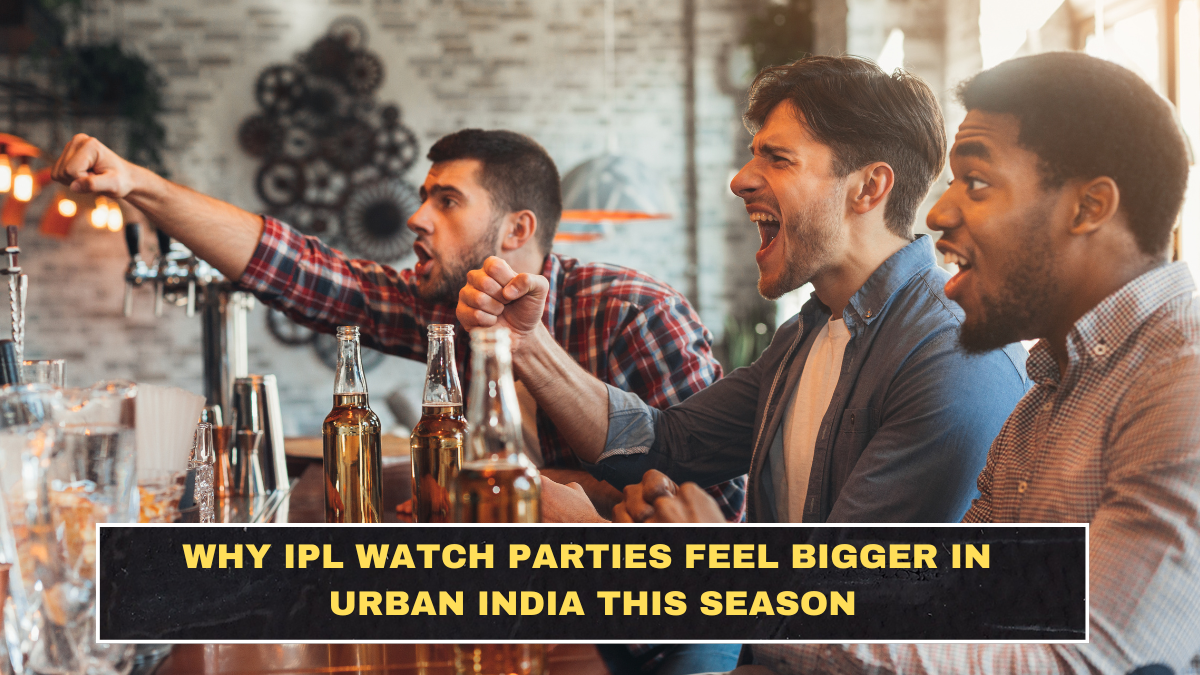
IPL was once something most people watched from their sofa, with snacks, WhatsApp groups, and constant shouting at the TV. That is still happening, but it is no longer the whole story. In 2026, the viewing experience feels far more public. Rooftop bars, pubs, fan parks, hotel lounges, and city venues are pushing IPL as a social event, not just a match broadcast. That shift is visible enough that Hindustan Times, Curly Tales, and multiple hospitality-led campaigns are treating “where to watch IPL” as its own lifestyle category.
That matters because it says something bigger about urban India. People are not just consuming cricket. They are using cricket as an excuse to go out, gather, spend, and be seen. The 2026 season is making that trend more obvious because public viewing has stronger institutional backing this time, especially through BCCI’s Fan Park expansion across smaller and non-host cities.

This Is Not Just a Bar Trend Anymore
The easiest mistake is to think IPL watch parties are only about a few trendy pubs in Delhi, Mumbai, or Bengaluru. That is outdated thinking. BCCI announced IPL 2026 Fan Parks across 15 cities in the first phase alone, spread over 11 states and three weekends starting March 28, 2026. The stated purpose was to take the IPL experience beyond stadiums and create community-led live screening environments for fans outside the main venues.
That changes the picture completely. Once cricket is deliberately packaged as an out-of-home community experience by the league itself, watch culture stops being a side effect of nightlife and starts becoming part of IPL’s wider fan-distribution strategy. In blunt terms, BCCI is not waiting for fans to improvise public energy on their own. It is helping manufacture it.
Why Public Watch Culture Is Growing
There are a few obvious reasons this feels bigger in 2026.
- Fans want stadium-like energy without stadium cost or travel.
- Hospitality venues know IPL drives food-and-drink footfall.
- Cities now treat match nights as lifestyle occasions, not just sports nights.
- BCCI itself is extending the viewing experience through Fan Parks.
You can see this in how venues are marketing the season. Hindustan Times published a full Delhi-NCR guide listing rooftop bars, hotel bars, and pubs for IPL 2026 screenings, while Curly Tales ran a similar roundup across Delhi, Jaipur, and Bengaluru. That is not normal coverage for something supposedly limited to hardcore cricket fans. It is lifestyle coverage because the audience is broader now.
The BCCI Fan Park Move Is a Big Reason
The strongest proof that IPL watch parties are getting bigger is not a bar menu or Instagram reel. It is the official Fan Park rollout. According to IPL’s official site, the first phase of Tata IPL Fan Parks in 2026 covers 15 cities across 11 states over the first three weekends of the season, including Rohtak, Bhopal, Nagpur, Tumakuru, Krishnanagar, Meerut, Madurai, Jorhat, Patiala, and others.
That does two things. First, it validates public screening as a core fan format. Second, it spreads the “watch together” culture beyond the usual metro nightlife pockets. When people in non-host cities get access to giant-screen screenings, live entertainment, and crowd-based match environments, the social idea of watching IPL expands. The match becomes an event even when no stadium is nearby.
| 2026 IPL public-viewing signal | What it shows |
|---|---|
| BCCI Fan Parks in 15 cities across 11 states | Public screening is being pushed as an official fan-engagement format, not just a private venue idea. |
| Hospitality guides for IPL screenings in Delhi-NCR, Jaipur, Bengaluru | Match viewing is becoming part of nightlife and leisure planning. |
| Venue campaigns like SOCIAL’s “Doosra Stadium” | Brands are building recurring match-day experiences around cricket crowds. |
| Stronger city crowd-management measures around IPL season | Demand around match attendance and related movement is intense enough to require planning. |
Why Urban India Especially Feels This
Urban India is the perfect environment for IPL watch parties because the season overlaps with exactly the kind of behavior cities already reward: after-work hangouts, group outings, spending on food and drinks, and short-form social plans. Cricket gives people a reason to gather without needing a wedding, holiday, or big pre-planned event.
That is why the format works so well in metros and large cities. A live match gives structure to the night, and the venue supplies atmosphere. Even people who are not obsessive fans still show up for the energy, the crowd reactions, and the feeling of being part of something live. In other words, the IPL watch party is not just about cricket. It is about shared urban entertainment. This is an inference supported by the breadth of hospitality coverage and activation campaigns around screenings.
Brands and Venues Are Turning It Into a Business
No one should pretend this is purely organic fan passion. Businesses are leaning into it because the economics make sense. Venues get repeat footfall across a long season. F&B sales climb. Brands get easy association with emotion, rivalry, and high-attention live moments. SOCIAL’s revived “Doosra Stadium” campaign for 2026 is a good example of how hospitality brands now treat the IPL season like a structured consumer event, complete with themed décor, activations, and high-energy match environments.
This is why the watch-party culture feels bigger: it is being produced from both sides. Fans want a more social match experience, and businesses want a monetisable crowd format. When those two incentives line up, trends stop being temporary. They become seasonal habits.
There Is Also a Safety and Crowd-Management Angle
Bigger public viewing culture also means bigger movement, bigger crowds, and more pressure on city systems. Bengaluru’s IPL 2026 preparations show that clearly. Recent reporting described expanded holding areas, more exits, stronger security deployment, AI-based crowd analytics, extra metro services, and ticket-linked public transport support around matches.
That matters for the broader story because cities do not put that much planning into an event unless demand is serious. Even if those measures are stadium-focused, they reflect the wider intensity around IPL nights in urban India. This is not a niche pastime anymore. It is city-scale behavior.
What This Says About Fan Culture in 2026
The deeper shift is that cricket fandom is becoming more performative, more communal, and more location-based. Watching alone at home is still the default for many people, but public viewing now offers something television at home cannot: noise, reactions, rivalry, and atmosphere. That is what fans are buying into.
The smarter reading is not “people love cricket more than before.” It is that people increasingly want live entertainment to feel collective. IPL is perfect for that because it is regular, emotional, city-linked, and easy to understand. In urban India, that combination turns a cricket match into a social plan.
Conclusion
IPL watch parties feel bigger in urban India this season because they are no longer a side trend. They are being pushed by bars, hospitality brands, lifestyle media, and the BCCI itself through Fan Parks and expanded public-viewing infrastructure. The result is a season where cricket is not only watched but staged socially across cities.
The honest takeaway is simple: this is not just about fandom. It is about how urban India now prefers to consume live culture. People want the match, but they also want the outing, the crowd, the food, the noise, and the social proof of being there. That is why IPL watch parties feel bigger. They are feeding a wider urban habit, not just a cricket one.
FAQs
Why are IPL watch parties growing in India in 2026?
They are growing because fans want shared match-day energy, venues want repeat seasonal footfall, and BCCI is officially expanding community viewing through Fan Parks.
What are IPL Fan Parks in 2026?
They are official public screening events that bring live IPL viewing, giant screens, and fan activities to cities outside the main stadium circuit. In the first phase of 2026, they cover 15 cities across 11 states.
Are IPL watch parties only a metro-city trend?
No. Urban nightlife venues are a major part of the trend, but the Fan Park expansion shows that public viewing is spreading into many non-host and smaller cities too.
Why does this trend matter beyond cricket?
Because it shows how live sports are increasingly becoming a social, nightlife, and out-of-home entertainment format in India, rather than just a TV event watched privately at home.