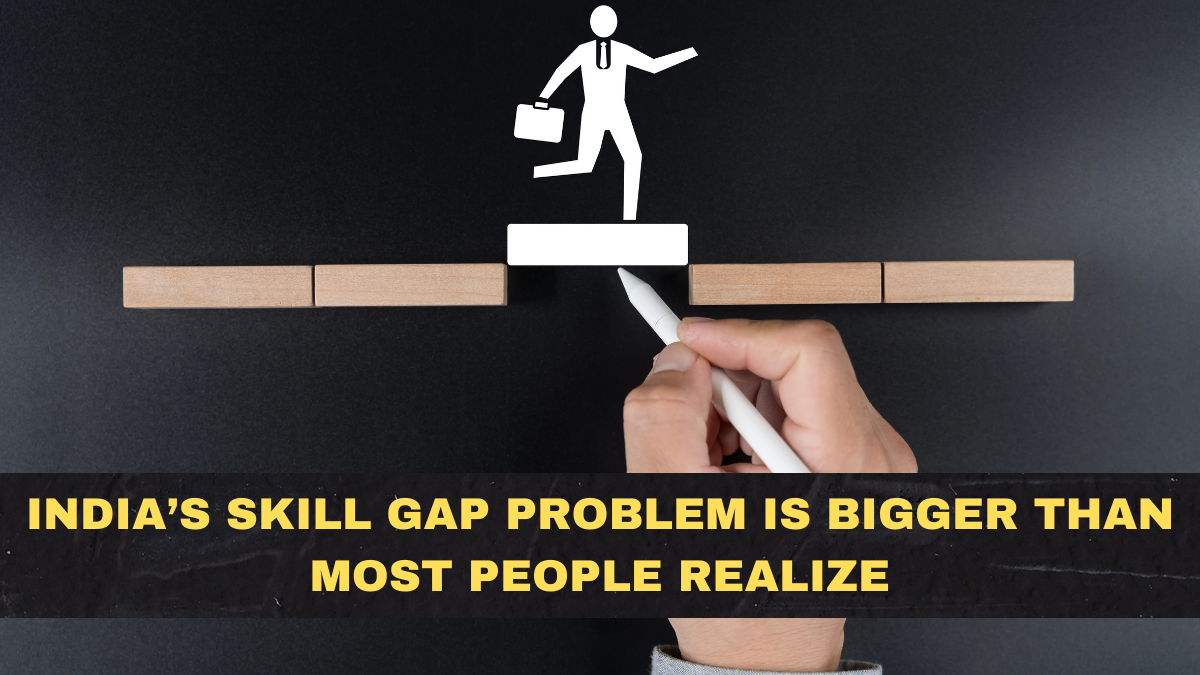
India is producing more graduates than ever before, yet employers across industries continue to complain about a lack of job-ready talent. This contradiction defines the skill gap problem in 2026. On one side, millions of educated young people struggle to find stable work. On the other, companies report difficulty filling roles that require practical capability, adaptability, and problem-solving.
The issue is not intelligence or effort. It is a disconnect between what education systems deliver and what the job market actually demands. India’s skill gap is no longer a niche policy concern; it is a structural challenge affecting productivity, wages, and long-term economic confidence.
What the Skill Gap Actually Means in 2026
The skill gap does not mean people lack degrees. It means they lack usable, applied skills relevant to real work environments.
Graduates often know theory but struggle with execution, communication, and decision-making. Employers spend months retraining new hires.
In 2026, the gap is about readiness, not qualification.
Why Degrees No Longer Guarantee Employability
Degrees were once a proxy for competence. Today, they signal completion, not capability.
Standardized curricula move slowly, while industries evolve quickly. By graduation, knowledge may already be outdated.
This lag turns degrees into weak hiring filters.
The Education System’s Focus on Marks Over Skills
Indian education still prioritizes exams, ranks, and memorization. Skill application is often secondary.
Students optimize for scores, not understanding. Practical exposure remains limited.
This creates graduates who perform well academically but struggle professionally.
Industry Expectations Have Shifted Quietly
Employers now value adaptability, communication, and hands-on problem-solving more than rote knowledge.
Job roles demand learning on the fly and cross-functional thinking. These are rarely taught formally.
In 2026, silent expectation shifts widen the skill gap further.
Why Internships Aren’t Solving the Problem
Internships are often short, unpaid, or poorly structured. Many students perform repetitive tasks without learning depth.
True mentorship is rare. Exposure replaces training.
As a result, internships fail to bridge the skill gap effectively.
The Role of Technology in Widening the Gap
Automation and tools change job requirements rapidly. Skills become obsolete faster than before.
Students struggle to keep pace without continuous learning frameworks.
Technology accelerates the gap between education and employment.
Why Employers Hesitate to Hire Freshers
Hiring unprepared candidates increases training costs and risk. Many employers prefer experienced hires.
This creates a vicious cycle where freshers can’t gain experience without being hired.
In 2026, the fresher dilemma remains unresolved due to the skill gap.
How the Skill Gap Affects Salaries
When skills are scarce, employers pay a premium. When skills are weak, wages stagnate.
Graduates without in-demand skills accept lower salaries, dragging overall wage growth down.
The skill gap directly impacts earning potential.
Why Upskilling Alone Isn’t Enough
Online courses promise quick fixes, but results vary widely. Without application, learning fades.
Upskilling must be structured, mentored, and practiced to matter.
In 2026, random certifications rarely close the gap.
Who Is Most Affected by the Skill Gap
Students from non-elite institutions feel the impact most strongly. They lack exposure and networks.
However, even top-college graduates are not immune if skills lag.
The skill gap cuts across backgrounds, though unevenly.
What Can Actually Reduce the Skill Gap
Early exposure to real-world problems helps. Learning through projects builds confidence.
Stronger collaboration between industry and education is essential.
Skill development must become continuous, not optional.
Conclusion: India’s Skill Gap Is a Systemic Challenge
India’s skill gap persists because education and employment move at different speeds.
In 2026, solving this gap requires honesty about outcomes, not more degrees or slogans.
Until skills are treated as core assets rather than add-ons, the gap will continue to limit both individual careers and national growth.
FAQs
What is India’s skill gap problem?
It is the mismatch between graduates’ abilities and the skills employers actually need.
Are degrees becoming useless because of the skill gap?
Not useless, but insufficient without applied skills and real-world exposure.
Why do companies avoid hiring freshers?
Because many freshers require extensive training before becoming productive.
Do online courses help reduce the skill gap?
Only when combined with practice, mentorship, and real application.
Is the skill gap only an education issue?
No, it involves education systems, employers, and policy alignment.
What is the most effective way to reduce the skill gap?
Project-based learning, early exposure, and continuous skill development.