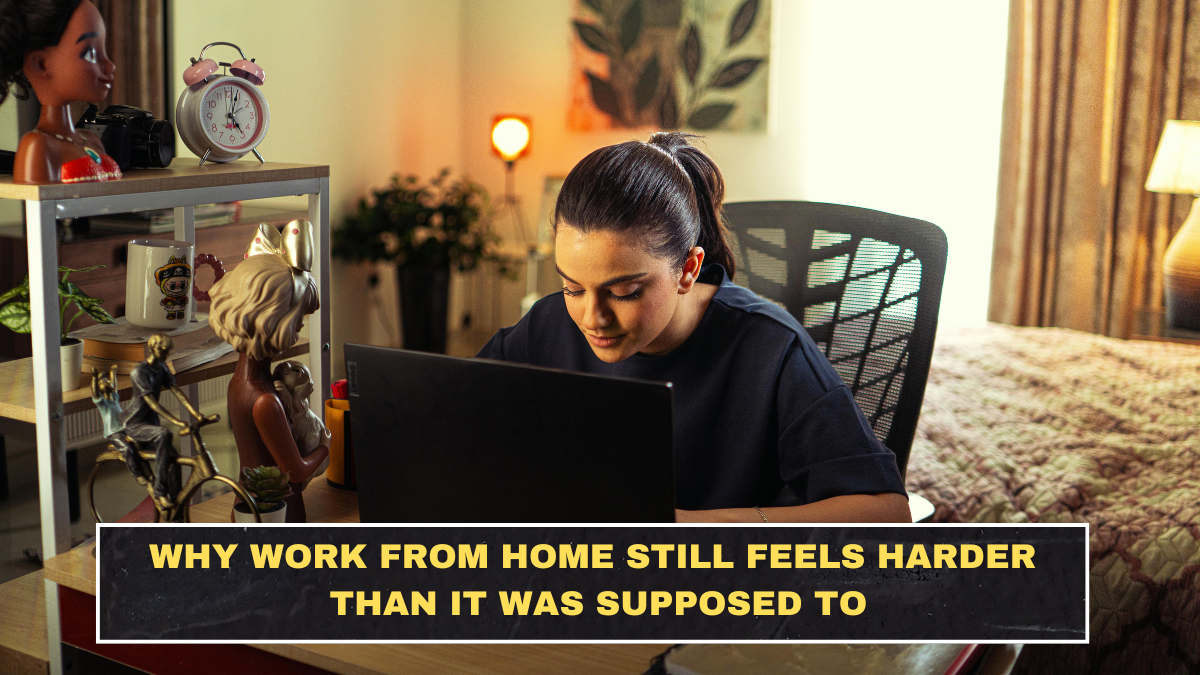
Work from home was sold as a cleaner, calmer, and more flexible way to work. No commute, fewer office interruptions, more personal control, and supposedly better work-life balance. On paper, that still sounds attractive. In real life, many workers do not feel that relief anymore. They feel constantly reachable, mentally crowded, and oddly unable to switch off even when they are physically at home. That is the real reason this topic still matters in 2026.
The problem is not that remote work “failed.” The problem is that many companies and workers quietly replaced one kind of stress with another. The old stress was traffic, office politics, and rigid hours. The new stress is message overload, blurred boundaries, endless check-ins, and the feeling that you are always half-working. Microsoft’s India findings earlier captured this clearly: 57% of Indian employees said they felt overworked, 32% felt exhausted, and 62% said their companies were asking too much of them. Those numbers were from the earlier hybrid transition stage, but the pressures behind them have not disappeared. In 2025, Microsoft’s newer global productivity-signal analysis showed the same pattern at a larger scale: workers face heavy email flow, nonstop messages, frequent interruptions, and increasingly extended workdays.
What Has Changed Since Remote Work First Felt Exciting
In the early phase of remote work, people mostly compared it with the worst parts of office life. That comparison made working from home feel like freedom. Over time, expectations changed. Managers wanted visibility, teams wanted faster replies, meetings became the default coordination tool, and employees started carrying their office in their pockets through chat apps, email, and video platforms. What felt flexible at first slowly became an always-on system.
India’s workplace data now shows a more mixed reality than the simplistic “remote is better” or “office is better” arguments. JLL’s 2025 Workforce Preference Barometer for India found that structured hybrid has become the norm, with 82% of Indian employees reporting mandated office days and 83% showing positive sentiment toward return-to-office mandates. Yet the same report also found that 54% of employees in India reported moderate to high burnout, and 2 in 5 were considering leaving their jobs within a year. That is the contradiction many workers are living inside: they may appreciate flexibility or even enjoy parts of the office, but they are still tired.
The Core Reasons Work From Home Still Feels Hard
The first reason is boundary collapse. Home used to mean recovery space. Now, for many people, it also means office, meeting room, cafeteria, and late-night desk. Once those boundaries disappear, the brain stops getting a clean signal that the workday is over. The International Labour Organization has repeatedly warned that digital and mobile work can blur work-life boundaries and increase stress, burnout, and psychosocial risks if not managed properly.
The second reason is digital overload. People often assume remote fatigue is caused by laziness or poor discipline. That is lazy thinking. In many cases, the real problem is attention fragmentation. Microsoft’s 2025 Work Trend analysis found that the average worker receives 117 emails a day and 153 Teams messages on a weekday. It also found that employees are interrupted every two minutes on average by a meeting, email, or notification. That means many workers are not doing deep work for long enough to feel satisfied. They spend the day reacting instead of progressing.
The third reason is that hybrid work created double pressure instead of balance for many people. They are expected to look fully available online while also performing when they come into the office. Instead of getting the best of both worlds, some workers get the burden of both. They carry commute fatigue on office days and notification fatigue on home days. That is why the phrase “hybrid flexibility” sounds better than it often feels in practice. JLL’s India report makes this visible: Indian employees may like the office experience, but burnout and attrition risk remain unusually high.
The Numbers Behind the Problem
The data matters because remote work debates are full of personal opinions and shallow hot takes. The more useful question is not whether work from home is good or bad. The useful question is what conditions make it sustainable, and what conditions make it draining.
| Indicator | What the data shows | Why it matters |
|---|---|---|
| Indian workers wanting flexible remote options | 74% | Flexibility is still strongly valued, so the issue is not that people hate remote work itself. |
| Indian workers wanting more in-person time with teams | 73% | People want flexibility and connection at the same time, which explains why simple one-sided models fail. |
| Indian employees feeling overworked | 57% | Remote and hybrid systems can raise workload pressure instead of reducing it. |
| Indian employees feeling exhausted | 32% | Fatigue is not abstract; it is directly reported by workers. |
| Indian employees with moderate to high burnout | 54% | Burnout remains a major issue even in today’s more structured hybrid environment. |
| Workers interrupted by messages/meetings/notifications | Every 2 minutes on average | Constant interruption destroys focus and makes work feel heavier than it should. |
| Average daily email load | 117 emails | A large part of fatigue now comes from communication management, not actual core work. |
| Average weekday Teams messages | 153 messages | The “infinite workday” problem is tied to message volume, not just long hours. |
Why It Feels Worse in India for Many Workers
The Indian context matters because work-from-home stress does not happen in a vacuum. It sits inside crowded cities, long commutes, family expectations, small living spaces for many households, and global team schedules that often stretch the day beyond normal office hours. For one worker, home may feel peaceful and productive. For another, home may mean noise, caregiving, limited privacy, and poor separation between work and life. That difference is one reason remote work outcomes vary so much.
There is also a cultural layer. In many Indian workplaces, visibility still carries weight. Even when companies talk about outcomes, many teams still reward quick replies, visible busyness, and meeting participation. That makes employees behave as if they are under silent surveillance, even without formal tracking tools. They stay online longer, answer messages faster, and overcompensate to prove they are working. Microsoft’s India data showed 50% of people responding to Teams chats within five minutes or less, which says a lot about the pressure to remain instantly available.
The Productivity Myth Most People Still Believe
A lot of people still talk about productivity as if it means doing more tasks from the same chair for more hours. That is a bad definition. Real productivity is meaningful output without unnecessary mental damage. If a worker clears messages all day, attends six meetings, and feels completely drained by evening, that is not a high-performance system. That is a badly designed workflow pretending to be efficient.
This is where remote work often gets misjudged. Many employees may still report acceptable output levels, but that output can come at a human cost. Microsoft’s India report already showed that self-assessed productivity held up for many people even while overwork and exhaustion rose. That should have been a warning. A system can look productive in dashboards while quietly exhausting the people inside it. That is exactly why work from home still feels harder than it was supposed to.
What Actually Makes Remote Work Easier
Remote work becomes easier when it stops being treated as permanent digital availability. It works better when teams reduce unnecessary meetings, define response-time expectations, protect focus blocks, and stop confusing speed with value. The goal is not to remove collaboration. The goal is to stop collaboration from swallowing the entire day.
The office also needs to be used more intelligently. JLL’s India findings suggest employees respond positively when office time has a clear purpose and a better experience attached to it. That means office days should be for collaboration, mentoring, and work that benefits from being together. Home days should be used for concentration-heavy work, planning, and quieter execution. When both environments serve the same chaotic purpose, hybrid work becomes a mess.
Simple Signs That Your Work From Home Setup Is the Real Problem
One sign is that you finish the day feeling busy but cannot name what important work actually moved forward. Another sign is that your day is full of small replies, quick calls, and constant checking rather than deliberate work. A third sign is emotional spillover: you are physically at home, but your mind never fully leaves work. That is not a motivation problem. That is a structure problem.
Another warning sign is when your schedule looks normal on paper but still feels exhausting. That often means hidden overload is doing the damage. The calendar may show breaks, but message traffic, app-switching, and after-hours catch-up fill the gaps. Microsoft’s 2025 data described this clearly: meetings take over prime productivity hours, message activity surges during key focus windows, and work often stretches into the evening. That pattern makes people feel behind even when they are constantly active.
What Workers and Managers Should Do Differently in 2026
Workers need to stop glorifying responsiveness. Being reachable every minute is not the same as being effective. Fewer app checks, clearer start-and-stop times, and dedicated focus windows matter more than fake busyness. People who do not protect their attention usually end up donating it to everyone else’s urgency.
Managers need to be more honest too. If every message feels urgent, the team design is broken. If meetings are used because leadership is unclear, that is a management failure. If employees need to stay visible online to feel safe, trust is weak. The best remote and hybrid systems are boring in the right way: clear rules, fewer interruptions, sensible office use, and realistic expectations around response times. Without that, work from home will keep feeling harder than promised.
Conclusion
Work from home still feels harder than it was supposed to because the problem was never just location. The real problem is overload, fragmentation, weak boundaries, and badly designed work rhythms. Remote work can absolutely be useful, flexible, and productive. But it stops feeling easy when companies dump office habits into digital tools and call that innovation.
The blunt truth is this: many people are not suffering from working at home. They are suffering from working everywhere, all the time, in too many channels, with too little clarity. Until that changes, the promise of work from home will keep sounding better than the lived experience.
FAQs
Why does work from home feel more tiring now than before?
It feels more tiring now because the novelty has faded and the hidden costs are easier to see. Many workers now deal with nonstop messages, meeting-heavy calendars, blurred personal boundaries, and pressure to stay visibly active online. The result is mental fatigue, not because home working is automatically bad, but because the structure around it is often weak. Recent productivity-signal research and workplace surveys both show that interruption and burnout remain major problems.
Is remote work still popular in India?
Yes, flexibility is still popular, but people do not want a simplistic all-remote or all-office answer. Microsoft’s India data showed strong interest in flexible remote options, while also showing a strong desire for in-person team connection. More recent India workplace research also suggests structured hybrid is the dominant reality now. The debate is no longer “remote or office” alone; it is about what mix actually supports people without exhausting them.
Does working from home reduce productivity?
Not automatically. The better question is whether the work system protects focus and reduces unnecessary friction. Many employees can stay productive from home, but productivity drops when the day is fragmented by notifications, ad hoc calls, and communication overload. If people are constantly reacting instead of concentrating, then the format may look flexible while output quality and energy both suffer.
What is digital overload in remote work?
Digital overload means the worker is dealing with too many emails, chats, meetings, alerts, and context switches across the day. It is not just screen time. It is the mental strain of constant input and repeated interruption. This is one of the biggest reasons remote work feels draining, because the brain rarely gets uninterrupted time to think deeply or finish important work properly.
Click here to know more