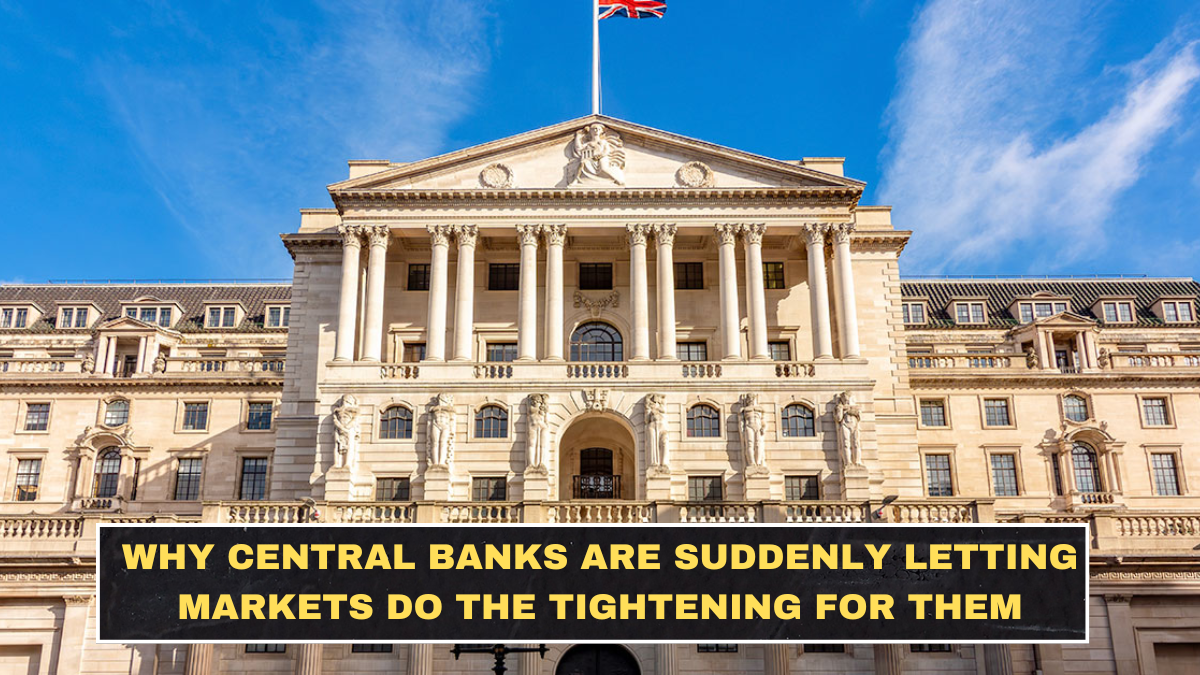
Central banks are suddenly more comfortable waiting because markets have already done part of their job for them. Reuters reported that the Iran war and oil shock have pushed up borrowing costs, widened credit spreads, lifted mortgage rates, and knocked down stock prices. That combination tightens financial conditions in much the same way a rate hike would. So the “wait and watch” approach is not passivity. It is recognition that markets have already slammed the brakes somewhat on their behalf.
The Federal Reserve is the clearest example. Reuters said markets have now pulled back expectations for the two Fed rate cuts that were priced in earlier this year, while Chair Jerome Powell has argued the Fed can afford to wait and see how much of the oil shock proves temporary. That matters because central banks do not want to overreact to a supply shock if markets are already tightening conditions enough to slow demand on their own.
What “markets doing the tightening” actually means
This phrase sounds abstract, but the mechanics are simple. When oil prices surge, investors demand higher yields, credit gets more expensive, equity markets weaken, and households and businesses feel less financially comfortable. That reduces spending appetite even without an official rate increase. Reuters described this as a market-driven tightening that closely mirrors the effect of a formal hike.
Here is the cleaner breakdown:
| Market move | What happened | Why central banks care |
|---|---|---|
| Bond yields rose | U.S. 10-year yields rose nearly 40 basis points in March | Higher yields tighten borrowing conditions |
| Oil surged | Brent was heading for one of its biggest monthly gains on record | Raises inflation risk while hurting growth |
| Stocks fell | Global equities weakened sharply, especially in Asia | Falling wealth and confidence can slow demand |
| Credit and mortgages got tighter | Reuters said borrowing and mortgage costs moved up | This does some of the central bank’s restraint work |
Why the Fed can justify waiting
Powell’s logic is not complicated. Energy shocks are usually supply-side events, and central banks are better at managing demand than fixing oil flows. Reuters said Powell told an audience at Harvard that the Fed can afford to wait because inflation expectations remain relatively anchored and because monetary policy is not well-suited to responding immediately to a war-driven oil spike. That is a cautious stance, not a soft one. If inflation expectations start drifting, the Fed can still act later.
This is also why the Fed is not rushing to hike just because oil is up. Hiking into a market that has already tightened sharply risks overcorrecting. That is especially true when energy shocks can hurt growth even as they lift prices. Reuters framed this as a classic policy complication: central banks need to judge whether the energy shock will dampen demand more than it boosts inflation.
Why Europe and others are in the same bind
The ECB and Bank of England face the same trap, just with less room for error. Reuters reported that markets have shifted toward expecting hikes from the ECB and BOE as oil and gas costs rise, but policymakers also know they could repeat the kind of mistake central banks made in 2011, when they reacted too aggressively to an oil spike and worsened a slowdown. ECB policymaker Yannis Stournaras said the ECB should react quickly only if inflation expectations drift or second-round effects build, which is basically a conditional version of “wait and watch.”
Australia shows the same logic in a slightly different form. Reuters reported that the RBA did hike in March, but its board was split and openly uncertain about the next steps because markets and oil had already complicated the outlook. That tells you this is not a single-country story. Central banks broadly are reacting to the same ugly mix: higher inflation risk, softer growth risk, and tighter market conditions already doing some damage.
Why this approach suddenly makes sense
A few points matter more than the noise:
- Central banks do not need to copy market tightening immediately if markets have already raised the economic cost of borrowing.
- Oil shocks are dangerous because they can raise inflation while also weakening demand.
- Waiting is rational when inflation expectations are still fairly contained and conditions are already tightening.
- The real trigger for action is not just high oil, but whether that shock spreads into wages, expectations, and broader pricing behavior.
Conclusion
Central banks are suddenly letting markets do the tightening for them because markets have already delivered part of the restraint that policymakers normally impose themselves. Higher yields, weaker stocks, wider spreads, and more expensive energy have tightened financial conditions without a synchronized wave of emergency rate hikes. The blunt truth is this: when markets are already hitting growth and confidence, waiting is not weakness. It is often the less stupid option.
FAQs
Why are central banks waiting instead of hiking immediately?
Because markets have already tightened financial conditions through higher yields, lower stock prices, and costlier credit, reducing the need for an instant policy move.
What did Jerome Powell say about the oil shock?
Reuters reported that Powell said the Fed can afford to wait and look through the oil shock unless inflation expectations begin to shift materially.
Why is this called “markets doing the tightening”?
Because rising market rates, weaker equities, and wider credit spreads restrain economic activity in ways similar to an official rate hike.
What would force central banks to act more aggressively?
A broader inflation drift, especially if higher energy prices start feeding into wages, long-term expectations, and second-round price increases.
Click here to know more