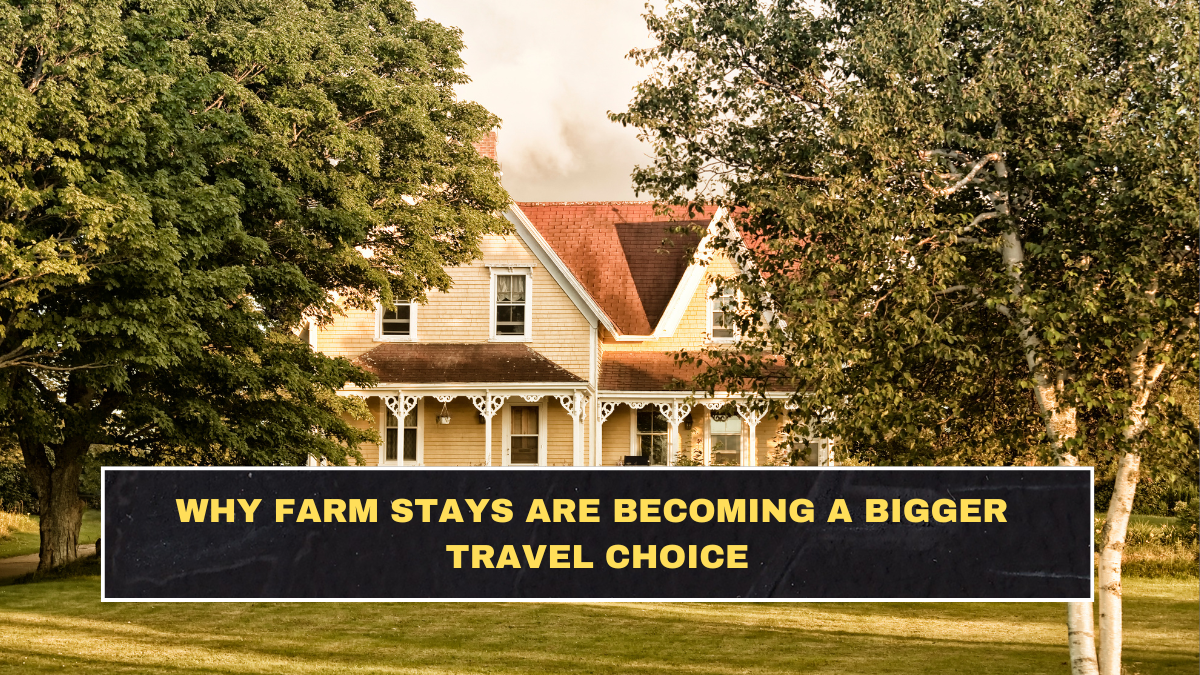
Farm stays are becoming a bigger travel choice because a lot of travelers are tired of trips that feel expensive, crowded, and weirdly empty at the same time. A farm stay promises the opposite: quieter surroundings, slower routines, and a closer connection to food, land, and local life. Condé Nast Traveler’s 2026 sustainability trends says travelers are showing growing interest in farm stays and rural retreats as part of a wider push toward slower, community-linked, less extractive travel.
This is not just a mood-board trend. Market data shows agritourism is growing as a real category. Grand View Research says the U.S. agritourism market is expected to grow at a 11.3% CAGR from 2025 to 2030, with North America holding the largest regional share in 2024. Future Market Insights also projects the global agritourism market to reach about $330.93 billion in 2026, with overnight stays accounting for 34.6% of activity demand.
Why are farm stays getting more popular now?
Because many travelers want trips that feel calmer and more grounded, not just busier. The same 2026 Condé Nast Traveler trends report ties farm stays to wider interest in community empowerment, off-season travel, and rural dispersal, which suggests travelers are increasingly open to places outside the usual city-break and beach-resort circuit.
There is also a reaction against over-tourism. Rural stays give people space, slower pace, and a different kind of value. Instead of chasing landmarks, they get a setting where the experience is the place itself. Future Market Insights’ agritourism outlook supports this by showing “overnight stay” as the largest activity format for 2026, which means travelers increasingly want immersive rural stays, not just short farm visits.
What do travelers actually get from a farm stay?
Usually they get some mix of quiet, scenery, local food, hands-on experiences, and a break from hyper-scheduled travel. That can mean waking up on a working farm, eating regionally grown food, walking through orchards or fields, joining simple farm activities, or just staying somewhere that feels less processed than a conventional hotel. Condé Nast Traveler’s 2026 report specifically links farm stays with reconnecting to nature and rural economies.
But let’s be honest: not every farm stay is some profound life reset. Sometimes it is just a prettier, slower place to sleep. That is still enough for many travelers. The appeal is often less about farming itself and more about escaping noise, crowds, and sameness.
Who is driving the farm stay trend most?
The trend is being driven by travelers who want slower, experience-led trips rather than standard checklist tourism. Future Market Insights points to rising middle-class leisure travel as one of the drivers in markets like India, and Grand View says direct booking made up 51.34% of agritourism bookings in 2024, which suggests many travelers are actively seeking these stays rather than stumbling into them through package deals.
It also overlaps with food tourism and wellness behavior. People increasingly want to know where food comes from, spend time outdoors, and choose trips that feel restorative rather than frantic. That makes farm stays attractive to families, couples, remote workers, and urban travelers who are bored of generic accommodation.
What kinds of farm stays are growing fastest?
The strongest growth seems to be in immersive overnight and rural-retreat formats rather than quick day visits. Future Market Insights says overnight stay is expected to be the biggest agritourism activity segment in 2026, which is a strong signal that people want more than a novelty photo stop.
Here is the practical breakdown:
| Farm stay type | Why people choose it | Best for | Main drawback |
|---|---|---|---|
| Working farm stay | Real rural atmosphere and hands-on experience | Families, curious travelers, slow-travel fans | Less privacy and less polished comfort |
| Boutique rural retreat | Countryside feel with better design and comfort | Couples, wellness travelers | Can feel expensive and less “real” |
| Food-focused farm stay | Local produce, cooking, vineyard or orchard appeal | Food travelers, short breaks | Often seasonal |
| Nature-first farm stay | Quiet, views, hiking, outdoor reset | Burned-out urban travelers | May feel too remote for some |
| Community-linked village or farm lodging | Stronger local connection and regional value | Ethical or regenerative travelers | Less predictable service standards |
That table matters because “farm stay” is not one thing. Some are close to rustic hospitality. Others are basically countryside boutique hotels with better branding.
Why does agritourism fit 2026 travel so well?
Because 2026 travel trends are leaning toward slower, more intentional, more place-based experiences. Condé Nast Traveler’s current reporting links farm stays with rural retreats and the broader move toward regeneration and dispersal. That lines up with market forecasts showing continued agritourism growth rather than a one-season spike.
Farm stays also fit the current pressure against crowded, peak-season travel. They work well with off-season planning, nature-led itineraries, and trips where the destination itself does not need to be globally famous to feel valuable.
Are farm stays always more sustainable?
No. This is where people get lazy. A farm stay is not automatically ethical, local, or low-impact just because it has fields and chickens nearby. Some truly do support rural economies and spread tourism more responsibly. Others are just aesthetic countryside lodging. The difference is whether the stay genuinely supports local production, employment, and destination resilience rather than simply borrowing rural imagery for marketing. Condé Nast Traveler’s 2026 sustainability reporting makes that broader point through its focus on community empowerment and rural dispersal.
So yes, farm stays can fit sustainable or regenerative travel. But only when there is actual local benefit, not just rustic décor and homemade jam at breakfast.
Who should skip a farm stay?
People who want flawless luxury service, dense nightlife, or nonstop sightseeing may find farm stays boring fast. These trips usually reward people who are comfortable with slower rhythms, simpler routines, and some unpredictability. If someone needs a trip to feel constantly active or highly polished, they may be better off elsewhere.
That is the part trend coverage softens too much. A farm stay works best when the traveler actually wants stillness, space, and a bit less control. If they only want an Instagram version of rural life without any inconvenience, disappointment is likely.
Conclusion
Farm stays are becoming a bigger travel choice because they match what many travelers want right now: quieter places, slower days, and experiences that feel more rooted than standard tourism. The growth of agritourism data backs that up, especially the strength of overnight stays. But the appeal is not universal. Farm stays work best for travelers who want calm, local character, and a break from crowded, high-speed travel. Everyone else is just chasing a rural fantasy they may not actually enjoy.
FAQs
Why are farm stays trending in 2026?
Farm stays fit broader 2026 travel shifts toward slower, rural, community-linked, and nature-based travel, and current sustainability trend coverage specifically identifies them as a growing area of interest.
Is agritourism really growing?
Yes. Grand View Research projects strong U.S. agritourism growth through 2030, and Future Market Insights projects continued global market expansion into 2036.
What is the biggest part of the agritourism market now?
Overnight stays are expected to be the biggest activity segment in 2026, which shows travelers increasingly want immersive rural experiences rather than short visits.
Are farm stays good for every traveler?
No. They suit travelers looking for slower, quieter, more grounded trips. People wanting fast-paced sightseeing, nightlife, or highly standardized luxury may find them underwhelming.