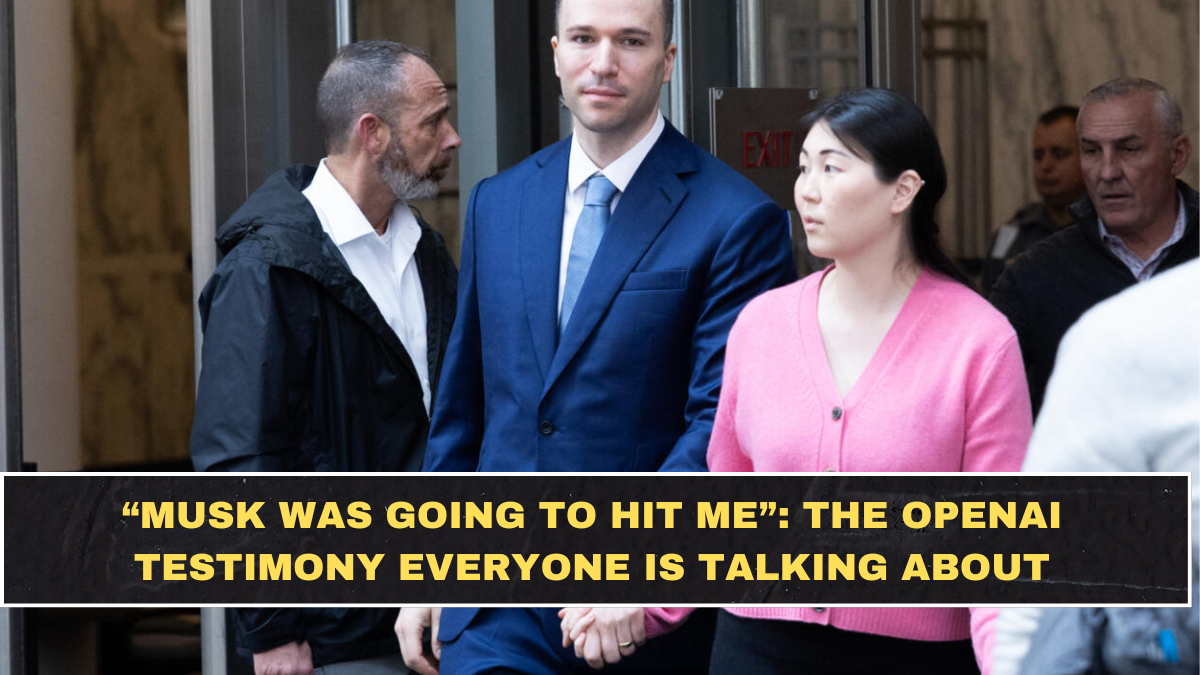
The Musk vs OpenAI trial has turned from a corporate lawsuit into a global AI power drama after OpenAI President Greg Brockman testified about a tense 2017 clash with Elon Musk. Brockman told the court that during a dispute over OpenAI’s future structure and control, he feared Musk might physically attack him. Wired reported Brockman’s testimony that he “actually thought” Musk was going to hit him during the confrontation.
That statement is explosive because the case is not only about old arguments between billionaires and founders. It goes straight to the biggest question in technology today: who should control the companies building advanced AI? Musk says OpenAI betrayed its nonprofit mission, while OpenAI’s side is trying to show that Musk himself pushed for control when the organisation was still trying to survive financially and strategically.
What Is Musk Actually Fighting For?
Elon Musk’s lawsuit accuses OpenAI and its leadership of abandoning the company’s founding nonprofit mission and turning it into a profit-driven AI giant. Reuters reported that Musk is seeking $150 billion in damages and wants the removal of OpenAI CEO Sam Altman and President Greg Brockman. That makes this one of the most consequential tech trials of the AI era.
| Key Point | What It Means |
|---|---|
| Case | Musk vs OpenAI and its leadership |
| Core Fight | Control, mission and profit in AI |
| Musk’s Claim | OpenAI betrayed its nonprofit purpose |
| OpenAI’s Defence | Musk wanted control and supported for-profit changes |
| Big Stakes | Future governance of powerful AI companies |
The brutal reality is that both sides are fighting over more than principle. This is also about reputation, control, money and the historical narrative of who “saved” or “betrayed” OpenAI. Anyone pretending this is only about public good is being naïve.
What Did Brockman Say About Musk?
Brockman’s testimony focused heavily on a 2017 meeting at Musk’s Bay Area mansion, where OpenAI’s structure and future funding were being discussed. Business Insider reported that Musk had demanded 51% equity and the CEO role, while Brockman and Ilya Sutskever resisted giving him unilateral control. The dispute reportedly escalated after Musk rejected the proposed governance structure.
Reuters also reported that Musk supported converting OpenAI into a for-profit entity but demanded majority control, arguing that he needed that control to help raise massive funds for his Mars ambitions. According to Brockman’s testimony, Musk wanted to raise $80 billion for a self-sustaining Martian city, and OpenAI’s future became tangled with that broader vision.
Why Is This Testimony So Damaging?
The testimony is damaging because it challenges the clean version of the story that OpenAI simply walked away from its founding ideals while Musk stayed loyal to them. If Brockman’s version is accepted, Musk was not just a donor defending a mission; he was also a founder trying to secure control over one of the most important AI labs in the world. That distinction matters enormously.
The most damaging claims include:
- Musk allegedly wanted majority control of OpenAI
- Brockman said he feared physical aggression during the dispute
- OpenAI’s team resisted giving one person unilateral power
- Musk allegedly threatened to stop funding after being refused
- The trial exposes how early AI governance decisions were messy and personal
But here is the uncomfortable part: Brockman’s testimony also does not automatically make OpenAI look pure. Fortune reported that Musk’s lawyers questioned Brockman about journal entries that could support parts of Musk’s claim that OpenAI’s leaders wanted to move toward a for-profit structure without him.
Why Does This Trial Matter For Everyone?
This trial matters because AI is no longer a side industry. OpenAI, xAI, Google DeepMind, Anthropic and other major labs are building tools that could shape work, education, national security and daily life. If the most powerful AI companies are controlled by a small group of founders, investors and board members, the public has a right to ask who keeps them accountable.
The trial also exposes a deeper failure: AI governance was built under pressure, ambition and personal conflict. The public conversation often talks about “safe AI” and “human benefit,” but the courtroom story shows money, control and ego sitting right beside those ideals. That is the real reason this case is gripping the tech world.
Conclusion: Is AI’s Future Really On Trial?
Yes, but not in the simple way social media is presenting it. The Musk vs OpenAI trial is not just a fight between Elon Musk, Sam Altman and Greg Brockman. It is a messy courtroom window into how one of the world’s most powerful AI companies changed direction, raised money and fought over control.
The blunt truth is that nobody in this fight looks completely clean. Musk wants to frame himself as the betrayed founder, while OpenAI wants to frame him as someone who wanted control and lost the fight. The verdict may decide legal responsibility, but the bigger question will remain: should the future of AI depend this much on private power struggles?
FAQs?
What is the Musk vs OpenAI trial about?
The trial centres on Musk’s claim that OpenAI abandoned its nonprofit mission and that its leaders benefited from turning it toward a profit-driven structure. OpenAI’s side argues that Musk himself supported structural changes but wanted control over the organisation.
What did Greg Brockman say about Elon Musk?
Greg Brockman testified that during a tense 2017 meeting, he feared Musk might physically attack him after Musk was refused absolute control over OpenAI. Wired and other outlets reported the claim from Brockman’s courtroom testimony.
How much money is Musk seeking from OpenAI?
Reuters reported that Musk is seeking $150 billion in damages in the case. He is also seeking the removal of OpenAI CEO Sam Altman and President Greg Brockman.
Why is this trial important for AI?
The trial is important because it raises serious questions about who controls advanced AI companies and whether public-interest missions can survive huge financial pressure. It also shows how personal power struggles shaped one of the most influential AI organisations in the world.