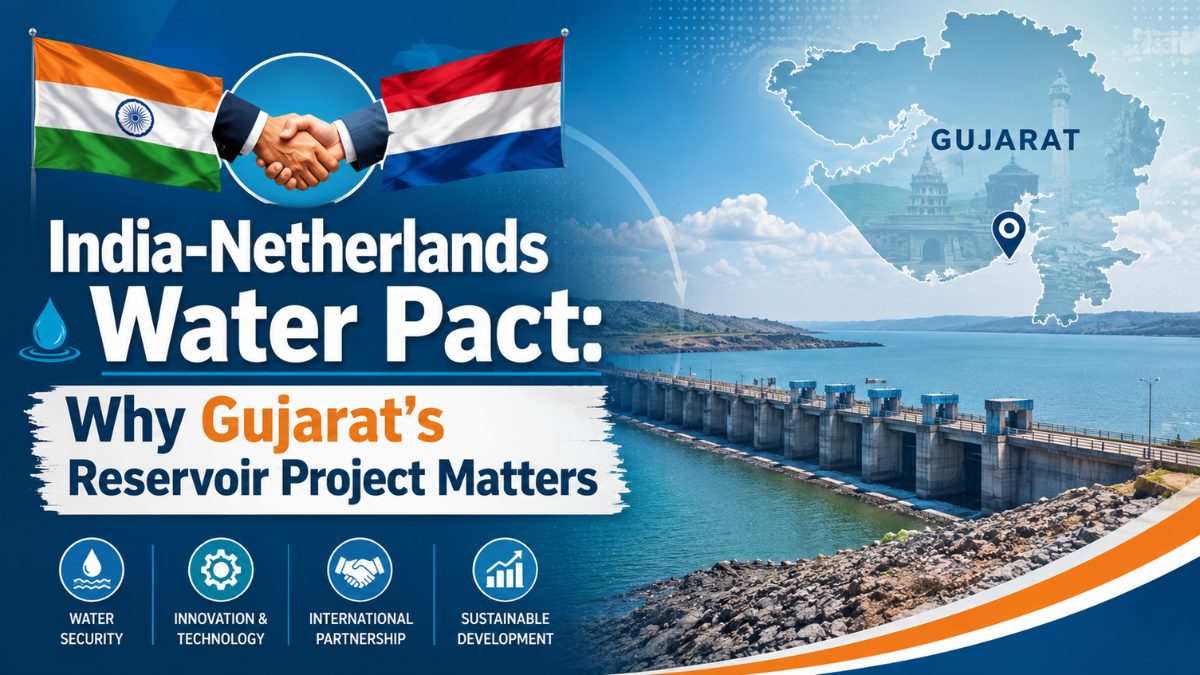
India and the Netherlands have signed a Letter of Intent to strengthen technical cooperation on Gujarat’s ambitious Kalpasar Project. The agreement was signed between India’s Ministry of Jal Shakti and the Netherlands’ Ministry of Infrastructure and Water Management on May 17, 2026, making the project a fresh talking point in India’s water-security and infrastructure debate.
The timing is important because India is facing rising pressure on drinking water, irrigation, industrial water supply and climate resilience. Gujarat’s coastal and semi-arid geography makes water planning even more urgent. The Netherlands, known globally for advanced water-management systems, can bring technical experience that India may find useful for large coastal-reservoir planning.
What Is Kalpasar Project?
The Kalpasar Project is proposed as a freshwater reservoir and dam across the Gulf of Khambhat in Gujarat. Reports say the project aims to create a massive reservoir that can support drinking water, irrigation and industrial needs, while also becoming a major long-term infrastructure asset for the state.
| Project Detail | What It Means |
|---|---|
| Project Name | Kalpasar Project |
| Location | Gulf of Khambhat, Gujarat |
| Core Idea | Freshwater reservoir with dam structure |
| Cooperation | India-Netherlands technical exchange |
| Main Benefit | Water security, irrigation and infrastructure |
| Key Challenge | Cost, design, ecology and execution |
This is not a small local project. Earlier reporting described the plan as involving a long dam across the Gulf of Khambhat and a very large freshwater storage system. If executed properly, it can affect agriculture, urban water supply, industry, transport connectivity and coastal planning in Gujarat.
Why Netherlands?
The Netherlands has deep experience in water control, flood protection, sea barriers and coastal engineering. During Prime Minister Narendra Modi’s visit to the Netherlands, he visited the iconic Afsluitdijk water-management structure with Dutch Prime Minister Rob Jetten, highlighting cooperation in water management and climate resilience.
PM Modi also noted that the technology used in the 32-kilometre barrier dam holds important lessons for Gujarat. That is exactly why this partnership matters. Gujarat does not only need money for a project of this scale; it needs serious technical review, climate-risk assessment and engineering knowledge before moving forward.
What Can Gujarat Gain?
Gujarat can gain access to Dutch knowledge in coastal reservoirs, dam design, flood control, water storage and climate-resilient infrastructure. If the project succeeds, it may help reduce future water stress in parts of the state and support long-term planning for agriculture, cities and industries.
Possible benefits include:
- More freshwater storage for dry periods
- Better irrigation support for farming regions
- Drinking water security for growing cities
- Industrial water supply for economic growth
- Possible transport and connectivity benefits
- Stronger climate-resilience planning
But nobody should pretend this is an easy win. A project of this size will need environmental clearance, financial discipline, technical feasibility, rehabilitation planning and long-term maintenance clarity. Big infrastructure can solve problems, but badly planned infrastructure can create new ones.
What Are The Risks?
The biggest risks are cost, ecological impact, siltation, salinity management, marine biodiversity concerns and execution delays. The Gulf of Khambhat is a complex coastal zone, so any major dam or reservoir structure needs careful study. Ignoring ecology in the name of development would be a short-sighted mistake.
The financial side is also serious. Earlier reporting placed the estimated cost of the project at around ₹1.57 lakh crore, which means public scrutiny must be sharp. When a project reaches this scale, vague optimism is not enough. Citizens need clear timelines, updated studies, cost control and transparent implementation.
Why Is This Diplomacy Too?
This pact is not only about water engineering. It also strengthens India-Netherlands cooperation at a time when climate adaptation, sustainable infrastructure and water security are becoming global diplomatic priorities. Countries are increasingly building partnerships around practical challenges, not only trade or defence.
For India, this is a chance to use international expertise for a domestic development challenge. For the Netherlands, it is an opportunity to expand its water-management partnership with one of the world’s largest developing economies. That makes the pact both technical and strategic.
Conclusion?
The India-Netherlands water pact matters because it can give Gujarat’s Kalpasar Project a stronger technical foundation. The Letter of Intent focuses on cooperation for a freshwater reservoir and dam across the Gulf of Khambhat, with Dutch water-management experience becoming central to the discussion.
The honest takeaway is simple: this project could become a major water-security breakthrough, but only if it is handled with scientific seriousness. Gujarat needs water, but it also needs ecological caution, transparent cost management and realistic execution. Dutch technology can help, but it cannot replace responsible planning.
FAQs?
What Is India-Netherlands Water Pact?
India-Netherlands water pact refers to the Letter of Intent signed for technical cooperation on Gujarat’s Kalpasar Project. It involves India’s Ministry of Jal Shakti and the Netherlands’ Ministry of Infrastructure and Water Management.
What Is Gujarat’s Kalpasar Project?
Kalpasar is an ambitious project proposed across the Gulf of Khambhat in Gujarat. It aims to create a large freshwater reservoir that can support drinking water, irrigation and industrial needs.
Why Is The Netherlands Involved?
The Netherlands has strong expertise in water management, sea barriers, flood protection and coastal engineering. India wants to use this technical knowledge for Gujarat’s large freshwater reservoir planning.
Can This Project Solve Gujarat’s Water Stress?
It can help if designed and executed properly, but it is not a magic solution. The project must address cost, ecology, salinity, rehabilitation, engineering risks and long-term maintenance before it can deliver real benefits.