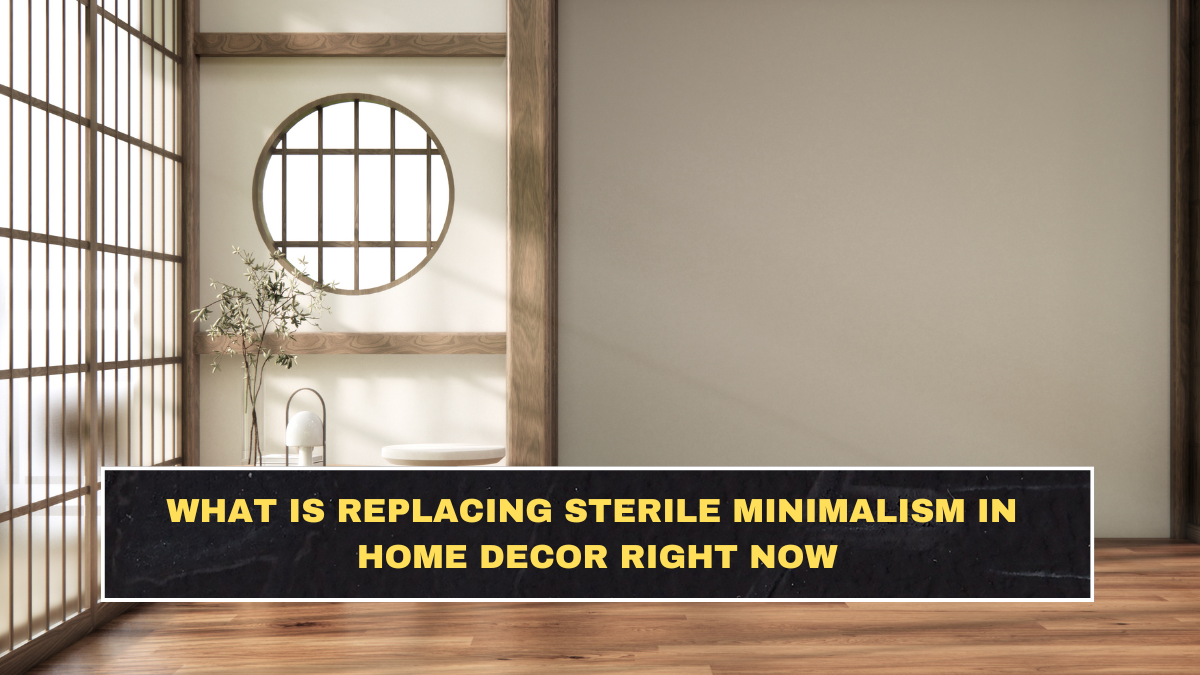
Sterile minimalism is being replaced by interiors that feel softer, warmer, and more believable to live in. The shift is not really about clutter winning. It is about people getting tired of rooms that look polished in photos but emotionally flat in real life. Vogue’s 2026 interior-trend roundup said homes are moving toward homespun, lived-in interiors, while Houzz’s 2026 trends coverage highlights warm textures, inviting details, curves, and layered comfort rather than hard-edged restraint.
The cleanest replacement for sterile minimalism is not one single style. It is a cluster of related styles: warm minimalism, found luxury, collected interiors, heritage-driven detail, and relaxed comfort-led spaces. Homes & Gardens went as far as saying that “found luxury” is replacing quiet luxury in 2026, meaning people want homes that feel collected and personal instead of overly controlled and perfectly matched.
Why are people moving away from sterile minimalism now?
Because it often feels better in theory than in practice. Minimal rooms can look expensive and calm in a photo, but in daily life they can also feel cold, unfinished, and strangely tense. Houzz’s most-saved living rooms and bedrooms of 2026 point toward warm textures, layered color, soothing details, and restful, inviting spaces, which shows what people are actually responding to when they save and share interiors now.
There is also a broader design mood change. Maison & Objet 2026 coverage from Houzz highlights heritage crafts, sculptural pieces, warm neutrals, and luxurious everyday objects, while Vogue’s 2026 interiors forecast puts lived-in character at the center of the year’s home aesthetic. In plain English, people still want beautiful homes, but they do not want homes that look like nobody is allowed to touch anything.
What styles are replacing sterile minimalism most clearly?
The strongest replacement styles are the ones that keep simplicity but add warmth, age, texture, and personality. Here is the practical breakdown:
| Replacement style | What defines it | Why it works | Main risk |
|---|---|---|---|
| Warm minimalism | Soft neutrals, texture, fewer harsh edges | Keeps calm without feeling clinical | Can still feel bland if too empty |
| Found luxury | Collected, meaningful pieces over perfect curation | Feels personal and realistic | Easy to become messy without restraint |
| Relaxed quiet luxury | Better materials, softer styling, lived-in ease | Looks refined without stiffness | Can become expensive fast |
| Heritage-influenced decor | Craft, vintage details, tradition, patina | Adds depth and character | Can feel heavy if overdone |
| Curved contemporary comfort | Rounded furniture, sculptural shapes, tactile finishes | Makes rooms feel approachable | Too many curves can look trend-chasing |
That table matters because people keep searching for one replacement term when the real shift is broader. Sterile minimalism is losing ground to any style that feels human instead of just edited.
What does “found luxury” mean, and why is it growing?
“Found luxury” is basically the idea that luxury should look collected, meaningful, and slightly imperfect rather than showroom-clean. Homes & Gardens says the trend replaces stricter quiet luxury with something more about how people actually live, focusing on collection and character rather than careful over-curation.
That matters because a lot of people liked the calm of quiet luxury but not the stiffness. Found luxury keeps the quality but adds more visible life: vintage pieces, textured materials, mixed eras, books, collected ceramics, and objects that suggest memory instead of perfect styling. It is a smarter answer to the same desire for elegance, just without the emotional chill.
How are curves, texture, and softness replacing hard-edged rooms?
One of the clearest signs of the shift is the rise of curves. Houzz’s 2026 trends report says rounded sofas, arched cabinet fronts, scalloped edges, fluting, and soft geometric patterns are helping reshape interiors into more fluid, approachable spaces. That is not a random aesthetic choice. Curves soften visual tension and make a room feel less strict.
Texture is doing the rest of the work. Houzz’s saved-bedroom and living-room coverage emphasizes layering, warm textiles, and inviting finishes, while Maison & Objet coverage highlights heritage crafts and luxurious details in everyday objects. This is why sterile minimalism is fading: people are replacing visual emptiness with tactile comfort.
Is “coastal grandmother” still the answer, or are there better alternatives now?
Coastal grandmother helped normalize softer, calmer, lived-in interiors, but it is no longer the whole conversation. The newer alternatives are less themed and more flexible. Instead of building a room around one internet label, people are pulling from collected neutrals, relaxed tailoring, warm woods, quiet nostalgia, and heritage textures. That is closer to what current 2026 design coverage actually shows. Vogue points to lived-in interiors, and Houzz points to warm, approachable rooms with personality rather than a single named aesthetic.
So the smarter move is not copying coastal grandmother literally. It is borrowing the emotional logic behind it: comfort, softness, and ease. Then updating it with richer texture, more curves, better materials, and more personal objects. Otherwise you are just copying a trend nickname after the market already moved on.
What should people add first if their home feels too sterile?
Start with the things that interrupt flatness. The easiest upgrades are usually:
| What to add | Why it helps most |
|---|---|
| Textured textiles | Break up smooth, cold surfaces fast |
| Warm wood or aged finishes | Add visual heat and depth |
| Rounded furniture or mirrors | Reduce hard visual lines |
| Collected objects with meaning | Make the space feel lived in |
| Softer lighting and layered lamps | Remove clinical brightness |
This is the part people overcomplicate. If your home feels sterile, the problem is usually not that it needs more stuff. It is that it needs better contrast, more softness, and more evidence of life. That logic is consistent with Houzz’s 2026 saved-room trends and broader design forecasting around warmer, more inviting interiors.
Will sterile minimalism disappear completely?
No, but it will keep softening. Even the sources pointing to new 2026 directions are not saying simplicity is dead. They are saying the colder version of simplicity is losing appeal. Houzz’s predictions, Vogue’s trend forecast, and Homes & Gardens’ move toward found luxury all point to the same thing: people still want calm homes, just not lifeless ones.
That means the future is probably not maximal chaos. It is selective warmth. Fewer harsh edges. Better texture. More story. Less pressure for the room to look untouched.
Conclusion
What is replacing sterile minimalism right now is not one perfect label. It is a broader move toward warm minimalism, found luxury, curves, texture, craft, and lived-in comfort. People still want homes that feel calm and intentional, but they no longer want those homes to feel cold, fragile, or emotionally empty. That is the real shift. The winning rooms now are not the most polished. They are the ones that feel most believable to live in.
FAQs
What is replacing sterile minimalism in 2026?
Warm, lived-in, texture-rich interiors are replacing colder minimalist spaces, with trends like found luxury, relaxed quiet luxury, curves, and heritage-inspired detail becoming more prominent.
Is quiet luxury still in style?
Yes, but it is evolving. Homes & Gardens says “found luxury” is replacing stricter quiet luxury with a more collected and realistic version of elegance.
Why do people want more lived-in interiors now?
Saved-room and trend reporting from Houzz and Vogue suggest people increasingly prefer homes that feel warm, layered, and restful rather than ultra-polished and emotionally flat.
What is the easiest way to make a minimalist room feel less sterile?
Add texture, softer lighting, warm materials, and a few meaningful collected objects. Those changes usually soften the room faster than adding more furniture does. This is an inference based on the 2026 interior trends highlighted by Houzz and Homes & Gardens.