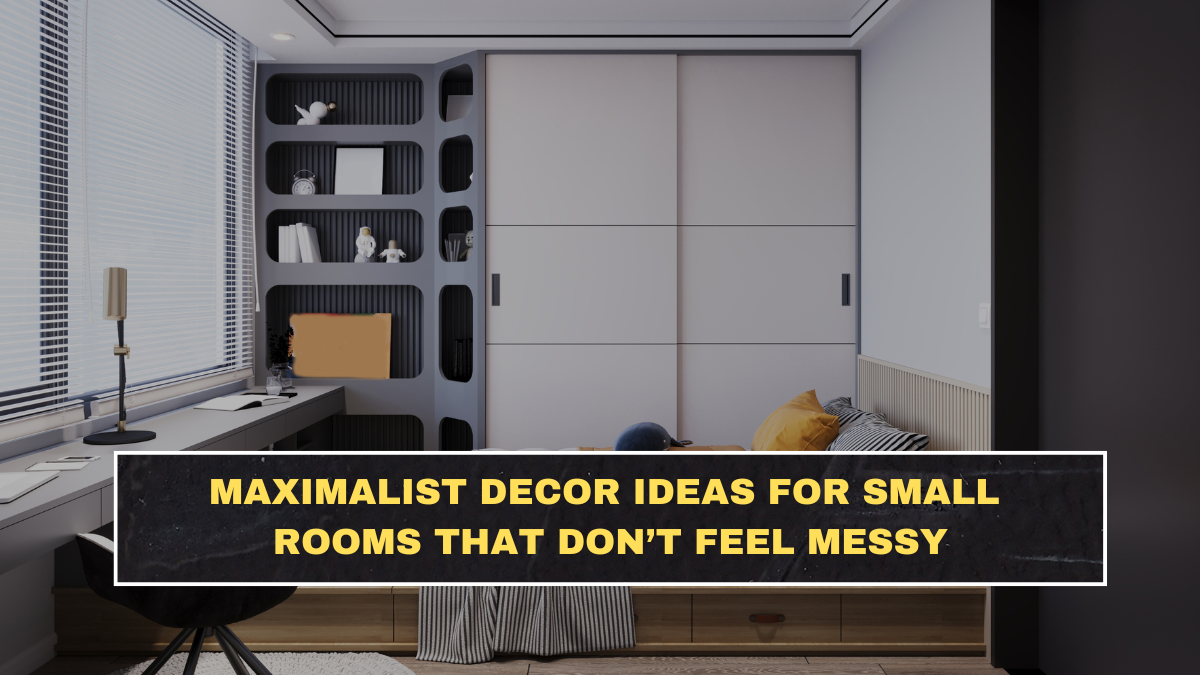
Maximalism is back, but a lot of people are doing it badly. They confuse layering with clutter, then wonder why the room feels stressful instead of rich. Current interiors coverage makes it clear that 2026 maximalism is less about random excess and more about personality, memory, and controlled visual depth. House Beautiful describes one of the big directions for 2026 as “narrative maximalism,” where rooms are shaped by personal taste, collected objects, and emotional resonance rather than a strict formula. Architectural Digest’s 2026 forecast also points to maximalist touchpoints and more expressive interiors as part of the current design shift.
That is important for small rooms because they punish lazy decorating fast. A small room cannot absorb chaos the way a large room sometimes can. The trick is not to decorate less. It is to decorate with more control. Homes & Gardens’ guidance on doing maximalism in a small room emphasizes color drenching, coordinated contrast, patterned layering, and statement pieces rather than just filling the room with more things. That is the real difference between a small room that feels richly layered and one that just feels crowded.
Why does maximalism work in small rooms at all?
Because small rooms can actually handle stronger visual identity better than people assume. Big blank minimalism is not automatically the smarter choice. In fact, darker or fuller treatments can make a compact room feel more intentional and cocooning rather than awkwardly underfurnished. Homes & Gardens recently highlighted deep colors such as denim blue, dark green, and rich brown as effective in small living rooms when used decisively, and Architectural Digest notes that color drenching remains a prominent technique in more expressive interiors.
The problem starts when people add “more” without a visual plan. House Beautiful’s 2026 design-trend coverage frames maximalism as personal and story-driven, not indiscriminate. So yes, a small room can absolutely hold wallpaper, layered textiles, art, books, antiques, and bold color. But those things need relationships. If every item is fighting for attention, the room stops feeling curated and starts feeling mentally loud.
Which maximalist moves work best in small rooms?
| Decor move | Why it works in a small room | Best use |
|---|---|---|
| Color drenching | Makes the room feel intentional and immersive | Walls, trim, even ceiling in one family |
| Layered textiles | Adds depth without taking up much floor space | Curtains, cushions, rugs, throws |
| One bold wallpaper zone | Creates character without visual overload | Accent wall, alcove, entry nook |
| Mixed art wall | Adds story and personality vertically | Above sofa, bed, desk, or console |
| Vintage and modern mix | Makes the room feel collected, not showroom-flat | Pair clean shapes with older details |
| Pattern with a controlled palette | Gives richness without chaos | Repeating tones across prints |
This is the real formula. Homes & Gardens specifically recommends color drenching, bold wallpaper, layered prints, and using a coordinated palette in small-room maximalism. House Beautiful’s 2026 trend reporting also points toward more personal, emotionally resonant spaces rather than sterile matching sets. That means maximalism works best when the room feels like it belongs to someone, not when it looks like an overstuffed prop set.
What is the easiest way to start a maximalist small room?
Start with the walls, not the objects. That is where most people get it backward. They buy more decor first, when what the room often needs is a stronger envelope. Color drenching is one of the easiest ways to make a small room feel deliberate, and it keeps coming up in 2026 interiors coverage as a major technique. Architectural Digest lists it among the most prominent design moves of the moment, while Homes & Gardens shows how deeper, moodier tones can actually help small spaces feel richer rather than tighter.
A strong wall treatment also makes the rest of the room easier. Once the room already has atmosphere, you do not need to compensate with endless objects. That is the trap a lot of people fall into. They decorate the surfaces because the structure underneath still feels boring.
How do you layer pattern without making the room chaotic?
Use repeated colors, not repeated prints. That is the cleaner rule. Homes & Gardens’ small-room maximalism guidance recommends pairing bold patterns while coordinating the colors, and House Beautiful recently described subtle patterns as the new neutrals when used well. That is useful because it gives people a way into layering without turning the room into visual static.
A striped cushion, floral curtain, and patterned rug can coexist if the palette overlaps. What fails is mixing unrelated motifs in unrelated colors and hoping the vibe will save you. It usually does not. Pattern needs structure the same way clutter needs editing.
What furniture choices keep a small maximalist room from feeling heavy?
Lighter-legged pieces help a lot. Homes & Gardens’ recent look at a pattern-drenched small living room emphasized that balance came from contrast, including lighter vintage pieces with visible legs that kept the layout from feeling too dense. That detail matters more than people realize. In small rooms, furniture that visually lifts off the floor creates relief even when the palette and patterning are rich.
This is also where “mix maximalism” is smarter than old-school heaviness. Homes & Gardens’ recent coverage of 2026-rich interiors points toward layered colors, textiles, and vintage-modern contrast rather than uniformly bulky furnishings. So if you want the room to feel layered and cozy, fine. But stop buying only heavy, dark, blocky pieces and calling it mood. Sometimes it is just bad visual weight distribution.
Which decor details add richness without taking much space?
Art, lighting, trims, window layering, cushions, and tabletop objects are the most efficient way to build maximalist depth. They add personality without eating the floor. House Beautiful’s 2026 whimsical-decor piece stresses that personal and emotional details matter more than just visual noise, while Homes & Gardens recently highlighted “double-dressed” windows as a layered treatment that adds both function and decorative depth.
This is why small-room maximalism often works better vertically than horizontally. Build the walls, windows, and upper sightlines before you stuff the corners. People who skip that step usually end up with crowded surfaces and dead walls, which is basically the worst version of maximalism.
What colors make maximalist small rooms feel richer instead of messier?
Darker or more saturated colors often work better than timid half-measures. Homes & Gardens recently highlighted shades like deep blue, rich green, and brown as powerful small-room colors, and House Beautiful’s 2026 paint-trend coverage also notes a move toward more expressive hues such as blue, plum, and pink. The point is not that every small room should be dark. The point is that conviction often looks better than fearful beige with random “fun” objects piled on top.
That said, a maximalist room does not need every color at once. One dominant family plus accent shades is usually stronger. Richness comes from depth and repetition, not color panic.
What mistakes make small-room maximalism feel messy?
The biggest mistake is treating every item as special. If everything is the star, nothing is. Another mistake is ignoring storage, which turns styling into clutter over time. A third is mixing patterns, colors, and furniture scales with no real rhythm. Homes & Gardens’ guidance on small-room maximalism keeps returning to coordination and controlled contrast for a reason. Even House Beautiful’s “narrative maximalism” idea still depends on coherence. Personal does not mean careless.
A more subtle mistake is refusing to edit. Maximalism is not a moral defense of keeping everything visible. Some things still need to be hidden so the displayed things can breathe. If you are not willing to edit, you are probably not doing maximalism. You are just keeping too much stuff in one room.
What is the smartest maximalist formula for a small room?
Pick one strong wall treatment, one repeated color family, one layered textile move, one art grouping, and one or two standout objects with emotional weight. That is enough. It gives the room story and richness without forcing every square inch to perform. Current 2026 interiors coverage repeatedly points toward layered, personal, expressive rooms, but the best examples still rely on cohesion and intention.
Conclusion
Maximalist decor works in small rooms when the room feels composed, not crowded. The strongest 2026 versions are personal, layered, and emotionally specific, but they still rely on color control, pattern coordination, lighter visual weight, and editing. House Beautiful’s narrative maximalism, Architectural Digest’s 2026 forecast, and current small-room advice from Homes & Gardens all point in the same direction: more is only better when it is organized around a point of view. If your small room feels messy, the answer is not automatically “less stuff.” It is probably better structure.
FAQs
Can maximalism work in a small room?
Yes. Current interiors guidance shows that small rooms can handle bold color, pattern, and layering well when the design is coordinated and intentional.
What is the easiest maximalist move for a small room?
Color drenching is one of the easiest strong moves because it instantly gives a room atmosphere and cohesion. It is also a major current design technique.
How do you stop maximalist decor from looking cluttered?
Use a controlled palette, repeat colors across patterns, choose lighter visual-weight furniture where possible, and edit what stays visible.
Do small rooms need light colors to feel bigger?
Not always. Recent small-room advice shows that richer, darker colors can make compact spaces feel more cocooning, elegant, and intentional when used well.