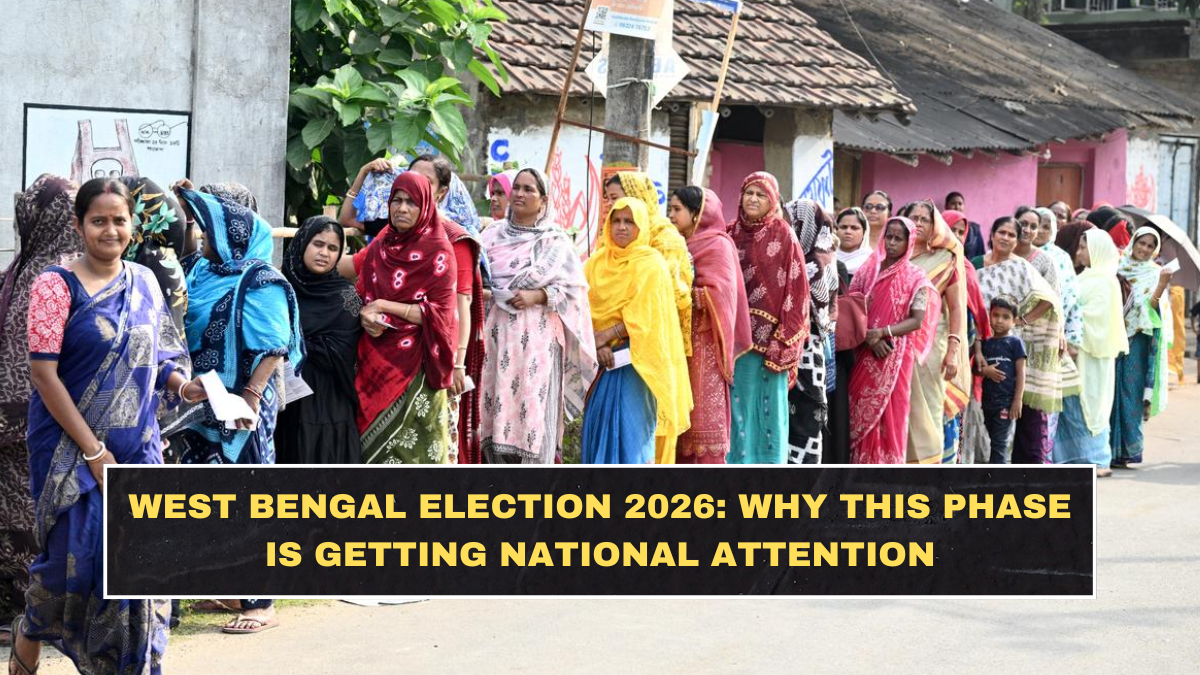
The West Bengal Assembly Election 2026 is getting national attention because the first phase has already delivered unusually high voter participation and intense political messaging. Voting is being held in two phases, on April 23 and April 29, with counting scheduled for May 4. That makes this election one of the biggest political stories of late April because the result will decide power in a 294-seat state assembly.
The first phase covered 152 constituencies, while the second phase will cover the remaining 142 seats. This matters because more than half the state voted in the first round, giving parties, analysts and voters early signals about turnout, mobilisation and campaign mood. But turnout is not the same as result. Anyone claiming victory before counting is selling confidence, not facts.
What Happened In The First Phase Of Voting?
The first phase saw record-level participation. News On AIR reported that West Bengal registered 92.7% turnout in the first phase, while NDTV reported 92.59% in its voting highlights. These figures are extremely high for a large assembly election and explain why the phase became a national talking point.
The bigger detail is that high turnout came despite major voter roll changes. Times of India reported that even after an 18 lakh drop in the electorate count after SIR-related roll revision, 24 lakh more people voted in the first phase compared with 2021. That makes the turnout politically important because it suggests unusually strong voter mobilisation.
| Election Detail | Latest Reported Information | Why It Matters |
|---|---|---|
| Total Assembly seats | 294 | Decides state government |
| Phase 1 seats | 152 | More than half the state voted |
| Phase 2 seats | 142 | Remaining seats vote on April 29 |
| Phase 1 turnout | Around 92.6%–92.7% | Record-level participation |
| Counting date | May 4, 2026 | Final result day |
| First phase issue | Voter roll revision and high turnout | Adds political uncertainty |
| Key contest | TMC vs BJP, with others in field | National political relevance |
Why Does Such High Turnout Matter?
High turnout matters because it shows voters were highly motivated, but it does not automatically tell us which party benefits. Political parties usually try to interpret high voting in their favour, but that is often wishful thinking. High turnout can indicate anger, loyalty, fear of exclusion, strong local mobilisation or a competitive contest.
In Bengal’s case, the turnout became more interesting because of the Special Intensive Revision, or SIR, of voter rolls. Reports said many names were removed during the voter list cleanup, and some voters returned from outside the state to vote because they feared being left out. That makes the voting pattern more complex than a simple “wave” explanation.
What Is The SIR Issue In Bengal Elections?
SIR refers to a voter roll revision process where names can be added, corrected or removed based on eligibility, duplication, death, shifting or absence. In Bengal, this became politically sensitive because large-scale deletion of names created debate around voter access, citizenship anxiety and electoral fairness.
NDTV reported that Bengal’s record turnout has been discussed in connection with a major voter purge, while Times of India reported that the Election Commission said the removal of absent, shifted, dead or duplicate voters raised the polling percentage. The key point is this: the voter roll issue has made the election more emotionally charged and politically sensitive.
Why Is The Second Phase Important?
The second phase on April 29 is important because it will cover 142 constituencies, including politically sensitive and high-density regions. After a record first phase, parties will try to use turnout narratives to energise voters in the remaining seats. That is why campaign statements after phase one have become sharper.
Union Home Minister Amit Shah claimed the BJP could win over 110 of the 152 first-phase seats, while framing the election as a shift from “fear to trust.” This is a political claim, not a result. The actual verdict will only come after counting on May 4, and treating campaign confidence as data would be bad analysis.
Why Is Security Also In Focus?
Security is in focus because Bengal elections have historically been watched closely for violence, intimidation and polling-day disruption. This time, the Election Commission reportedly said no repolling was recommended in West Bengal after the recent voting, which it described as a break from past patterns. That is a major administrative point if it holds across phases.
At the same time, the Election Commission also directed the suspension of five police officials, including an IPS officer, from Diamond Harbour over allegations of misconduct and failure to maintain impartiality. It also appointed 11 additional Police Observers for the second phase. So the election is not free from controversy; the system is still under pressure.
| Issue To Watch | What Has Been Reported | Why It Matters |
|---|---|---|
| No repoll recommendation | EC sources reported no repolling after recent voting | Suggests smoother polling conduct |
| Police suspensions | 5 officials suspended in Diamond Harbour | Raises impartiality concerns |
| Extra observers | 11 additional Police Observers appointed | Shows heightened vigilance |
| Bike movement order | HC reduced general two-wheeler ban to 12 hours | Balances security and mobility |
| Motorcycle rallies | 48-hour rally ban upheld | Prevents possible disruption |
Why Did The Bike Movement Order Become News?
The bike movement order became news because election security measures can directly affect ordinary voters. The Calcutta High Court reduced the Election Commission’s earlier 48-hour ban on general two-wheeler movement to 12 hours on polling day, while keeping the full 48-hour ban on motorcycle rallies.
This detail matters because Bengal’s election management is not only about party speeches. It is also about how voters move, how authorities prevent intimidation and how courts balance security with basic public movement. In a close election, even logistical rules can become politically sensitive.
What Are The Main Political Themes In This Election?
The main themes include governance, welfare delivery, identity, jobs, corruption allegations, voter roll revision, law and order, and migration-related anxieties. The TMC is defending power, while the BJP is trying to convert its campaign intensity into seats. Other parties are also contesting, but the national focus is heavily on the TMC-BJP battle.
The danger for readers is getting trapped in party propaganda. Every side will claim that turnout proves support for them. It does not. Turnout proves voters showed up. Results prove who they chose. Until May 4, the honest position is that Bengal is politically charged, highly mobilised and still uncertain.
What Should Voters And Readers Watch Next?
The most important things to watch are second-phase turnout, complaints filed with the Election Commission, security incidents, party-wise booth mobilisation and final counting trends on May 4. Exit narratives before counting should be treated carefully because Bengal politics often produces strong claims from all sides.
Readers should also watch whether the high first-phase turnout repeats in the second phase. If it does, it will confirm that this is not a one-region spike but a statewide mobilisation pattern. If turnout falls sharply, analysts will need to separate regional enthusiasm from broader state mood.
Conclusion?
West Bengal Election 2026 is getting national attention because the first phase delivered record-level turnout, major voter-roll debate, strong party claims and tight security monitoring. With 152 seats already voted and 142 still going to polls on April 29, the election is entering its most important stretch before counting on May 4.
The blunt truth is that nobody should confuse noise with results. High turnout, campaign claims and viral speeches can shape perception, but they do not replace counting. The only honest reading right now is that Bengal’s election is highly charged, turnout is unusually strong, and the final result remains open until votes are counted.
FAQs
When Is The West Bengal Election 2026 Being Held?
The West Bengal Assembly Election 2026 is being held in two phases on April 23 and April 29. Counting of votes is scheduled for May 4, 2026.
How Many Seats Are There In The West Bengal Assembly?
The West Bengal Assembly has 294 seats. The first phase covered 152 constituencies, while the second phase will cover the remaining 142 seats.
What Was The Turnout In The First Phase?
The first phase recorded around 92.6% to 92.7% voter turnout, according to reports from NDTV and News On AIR. This made the phase one of the most discussed election events of the week.
Why Is The SIR Issue Important In Bengal?
The SIR voter roll revision is important because large-scale name removals and corrections affected the electorate size. Reports linked the record turnout partly to voters returning to ensure they were not left out of the electoral process.
When Will West Bengal Election Results Be Declared?
The West Bengal Election 2026 results will be declared after counting on May 4, 2026. Until then, party claims and turnout interpretations should not be treated as final results.