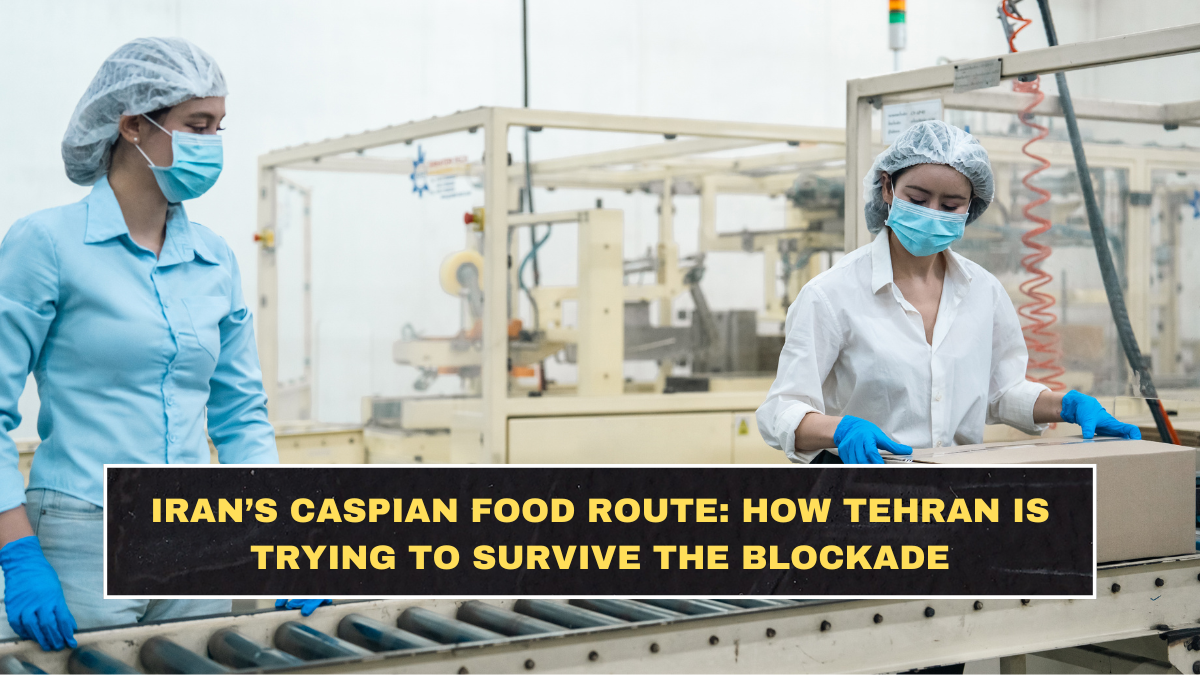
Iran is turning to the Caspian Sea because its usual Gulf and southern port routes are under severe pressure from the US blockade and wider war-related shipping disruption. Food suppliers are reportedly rerouting imports through northern routes to keep essential goods moving into the country. This is not a normal logistics adjustment. It is a survival move under pressure.
NBC’s live updates, citing regional reporting, said food suppliers are rerouting imports through the Caspian Sea as the US tries to squeeze goods entering and leaving Iranian ports. The head of Iran’s Food Industries Association said alternative import routes are being incorporated into the supply chain for essential goods. That is the clearest sign that Tehran knows the blockade is hurting, even if officials try to project confidence.
Why Are Iran’s Normal Food Routes Under Pressure?
Iran’s normal food-import system relies heavily on access through southern ports and maritime routes connected to the Persian Gulf. When those routes are disrupted by a blockade, ship inspections, insurance risks, and military tensions, importers must find alternatives. But switching routes is expensive, slower, and less efficient.
Reuters reported that maritime traffic through the Strait of Hormuz has fallen sharply, from around 125–140 daily transits to just seven, with no oil export cargo moving through in that snapshot. The US blockade had also turned back 37 ships since April 13, including Iranian oil tankers. Even though the report focused heavily on oil and shipping, the same maritime pressure affects food, industrial goods, packaging, and basic imports.
| Route Or Pressure Point | What Is Happening? | Why It Matters For Food? |
|---|---|---|
| Persian Gulf ports | Blockade and shipping disruption | Slows normal import flows |
| Strait of Hormuz | Traffic sharply reduced | Raises risk, delays, and insurance costs |
| Caspian Sea route | Being used as an alternative | Helps food enter from the north |
| Supply chains | Packaging and transport disrupted | Raises prices of basic goods |
| Domestic economy | Inflation and job losses rising | Families feel food pressure faster |
What Kind Of Food Pressure Is Iran Facing?
Iran is facing pressure on basic goods, not just luxury imports. AP reported that prices of chicken, beef, dairy and other basic goods have soared because of supply-chain disruption, damaged industrial infrastructure, blockade pressure, and wider economic strain. The report also said at least 1 million jobs have been lost, with up to 12 million more at risk if the crisis deepens.
This matters because food insecurity does not always begin with empty shelves. It often begins when ordinary families can still find goods but can no longer afford them. If wages collapse, jobs disappear, transport costs rise, and imports become harder, food inflation becomes a political problem. Tehran is not only trying to feed the country. It is trying to prevent food prices from becoming another trigger for unrest.
Why Is The Caspian Route Useful But Limited?
The Caspian Sea route is useful because it gives Iran access through the north, connecting it with countries such as Russia, Kazakhstan, Azerbaijan and Turkmenistan. That can help import grain, food ingredients, and other essential goods while southern routes remain choked. It also fits Iran’s broader strategy of using non-Western trade corridors to reduce dependence on vulnerable Gulf routes.
But the Caspian route is not a magic solution. It has capacity limits, port constraints, rail and road bottlenecks, customs issues, and higher overland transport costs. The Guardian reported that Iran has been seeking alternative market access through Russia and routes such as the Caspian Sea, but analysts described those routes as insecure and insufficient. That is the key point: Caspian imports may reduce the pain, but they cannot fully replace normal trade flows.
Why Is Food Import Diversion Politically Sensitive?
Food import diversion is politically sensitive because it exposes weakness. Governments under pressure prefer to say everything is under control. But when suppliers are forced to reroute essential goods, it shows that the blockade and war are disrupting the real economy. The public may not care about diplomatic wording; they care about prices in markets and food in homes.
Iran has long experience with sanctions, smuggling networks, barter arrangements, and alternative trade routes. That gives it some resilience. But resilience should not be confused with strength. A country that can survive pressure is not the same as a country that is unaffected by pressure. Tehran’s Caspian move shows adaptability, but also stress.
How Could This Affect Iranian Households?
Iranian households could feel the pressure through higher prices, fewer product choices, delays in supplies, and weaker purchasing power. If food importers must use longer and more expensive routes, those costs usually move down the chain. Traders, wholesalers, retailers, and consumers all absorb pieces of the shock.
The biggest burden will fall on lower-income families. Wealthier households can handle higher food prices for longer. Poorer families cut meat, dairy, fruit, protein, medicine, and other essentials first. That is how a shipping crisis becomes a nutrition crisis. It does not need to create famine to damage public health and family stability.
Could The Caspian Route Help Iran Beat The Blockade?
It can help Iran reduce the blockade’s impact, but it cannot beat the blockade completely. Alternative routes are useful for essential supplies, but they are slower and less efficient than major maritime trade corridors. They also depend on cooperation from neighbours, functioning logistics, available ships, rail capacity, and payment channels.
The US blockade is designed to squeeze Iran’s economy by making normal trade more difficult. Iran’s Caspian route is designed to keep enough goods moving to prevent collapse. That means this is not only a logistics battle. It is a contest of endurance: can Washington apply enough pressure to force concessions, or can Tehran absorb the pain long enough to make the US compromise?
Why Does This Matter For The Wider Region?
This matters beyond Iran because food-route disruption can affect neighbouring trade, Caspian logistics, grain markets, shipping insurance, and regional diplomacy. If Iran starts relying more heavily on northern partners, Russia and Caspian states may gain more leverage over Tehran. That could shift trade patterns and deepen Iran’s dependence on non-Western networks.
It also matters because food pressure can fuel unrest. Iran has already faced protests linked to economic pain, inflation, and restrictions. If food prices continue rising while internet restrictions and job losses deepen, the government could face more domestic anger. A country can survive military pressure, but food inflation is often more politically dangerous than leaders admit.
What Should Readers Watch Next?
Readers should watch three things. First, whether Iran’s basic food prices continue rising. Second, whether northern import flows through the Caspian Sea expand in a visible way. Third, whether the blockade remains in place or becomes part of a US-Iran compromise over the Strait of Hormuz and nuclear talks.
The most important signal will be domestic stability. If Iranian officials keep saying supplies are secure but prices keep rising, the public will believe the market, not the speeches. Food logistics is one of the easiest places to detect whether a government’s confidence is real or fake.
Conclusion
Iran’s move toward the Caspian Sea food route shows that Tehran is adapting to blockade pressure, but it also shows the blockade is biting. Alternative northern routes can help keep essential goods moving, especially as Persian Gulf shipping becomes dangerous and restricted. But these routes are not large enough, cheap enough, or secure enough to fully replace normal trade.
The blunt truth is that Iran is not collapsing, but it is being squeezed. The Caspian route may buy time, reduce shortages, and protect some food imports. It will not erase inflation, job losses, supply-chain damage, or public frustration. In a long blockade, survival is possible, but survival gets expensive.
FAQs
Why is Iran using the Caspian Sea for food imports?
Iran is using the Caspian Sea route because Persian Gulf and Strait of Hormuz routes are under pressure from the US blockade and war-related shipping disruption. Northern routes help keep essential goods entering the country.
Can the Caspian route replace Iran’s normal import routes?
No. The Caspian route can help reduce pressure, but it has capacity limits, higher logistics costs, and infrastructure constraints. It is an emergency workaround, not a full replacement for normal maritime trade.
Are food prices rising in Iran?
Yes. AP reported that prices of basic goods including chicken, beef and dairy have soared due to supply-chain disruption, blockade pressure and wider economic damage.
Why does food import disruption matter politically?
Food disruption matters because rising prices can create public anger, especially when wages fall and jobs disappear. If ordinary families struggle to afford basic goods, the crisis can quickly become a political stability problem.