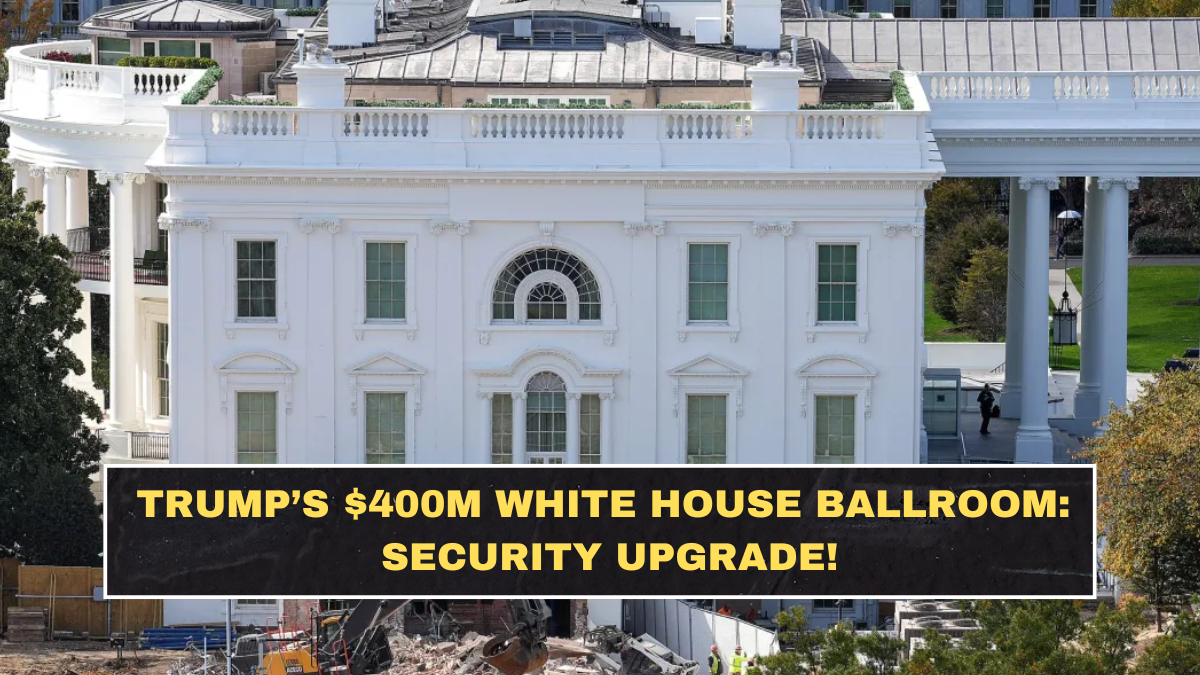
Donald Trump’s proposed $400 million White House ballroom is back in the headlines because his administration and Republican allies are using the recent White House Correspondents’ Dinner shooting to argue that the project is now a security necessity. Supporters say a large secure venue inside the White House complex would reduce the need for presidents to attend major events at hotels and outside locations.
AP reported that the National Trust for Historic Preservation refused to drop its lawsuit against the ballroom project after the Justice Department asked it to withdraw following the shooting. The Trust said the security incident does not erase legal requirements for congressional approval and preservation review. That is the core dispute: is this a serious security upgrade, or is security being used to push through a controversial luxury project?

What Is The White House Ballroom Project?
The project is a proposed large ballroom and East Wing rebuild at the White House, estimated at around $400 million. Trump has said the ballroom would provide a grander, more secure space for state dinners, official events, and large presidential gatherings. Supporters argue that the existing White House event spaces are too small for modern diplomatic and political needs.
The controversy is that the project involves major changes to historic White House grounds and followed the demolition of the East Wing. AP reported that Trump says the ballroom would seat 999 people, while public funds would cover a new underground bunker and security upgrades even though the ballroom itself has been described as privately funded. That mix of private donations, public security spending, historic demolition, and presidential branding is exactly why critics are furious.
| Issue | Supporters’ Argument | Critics’ Argument |
|---|---|---|
| Security | Keeps major events inside White House grounds | Shooting is being used as political cover |
| Cost | Private donations can fund much of it | Public money still funds security upgrades |
| Historic preservation | White House needs modern event capacity | East Wing demolition bypassed proper approval |
| Legal process | Congress can approve and fast-track it | Project should not proceed without review |
| Public image | Useful national venue | Looks like vanity construction during crisis |
Why Are Republicans Pushing The Project Now?
Republicans are pushing the project now because the dinner shooting gave them a stronger security argument. Reuters reported that congressional Republicans are advancing legislation to build and fund the ballroom, with supporters arguing that it would help prevent security breaches like the shooting at the White House Correspondents’ Association Dinner. The proposal could include taxpayer funding, including money from customs fees.
This timing is politically convenient. Before the shooting, the ballroom looked like an expensive and controversial renovation. After the shooting, supporters can frame it as presidential protection. That does not automatically make the argument false, but it does make it strategically useful. Security is one of the easiest ways to make an unpopular project harder to oppose.
Why Is The National Trust Fighting The Project?
The National Trust is fighting because it says the administration moved ahead without proper legal approval, including congressional and federal-agency review. The group is not arguing that presidential security is unimportant. It is arguing that security cannot be used to ignore preservation law, public review, and constitutional limits on executive power.
According to AP, the Trust filed its lawsuit after demolition of the East Wing began, claiming Trump bypassed required approvals. The group says it supports legitimate underground security work but opposes above-ground construction that changes historic White House grounds without the correct legal process. That distinction matters because critics are not saying “do nothing for security.” They are saying “do not use security to justify everything.”
Is This Really About Security?
Partly, yes. Large presidential events outside the White House do create security risks. Hotels, banquet halls, and external venues require temporary protection perimeters, public-street coordination, guest screening, motorcade movement, and emergency evacuation planning. A secured White House venue could reduce some of those risks.
But security is not the whole story. If this were only about protection, the debate would focus mostly on bunkers, exits, blast resistance, screening systems, and emergency operations. Instead, the project also involves a huge ballroom, historic demolition, donor questions, political branding, and architectural criticism. That is why calling it purely a security project is too convenient.
Why Are Critics Calling It A Vanity Project?
Critics call it a vanity project because the scale, style, and timing make it look more like Trump’s personal legacy project than an urgent national need. The proposed ballroom is expensive, highly visible, and tied closely to Trump’s taste for grand ceremonial spaces. Critics argue that the White House should not be remodelled around one president’s aesthetic preference.
The criticism gets sharper because Trump originally presented the project as privately funded, while Reuters reported that Republican legislation could involve public money, including hundreds of millions connected to customs fees and security infrastructure. Once taxpayer money enters the conversation, the “private project” defence becomes weaker.
What Is The Legal Fight About?
The legal fight is about whether Trump can move forward with such a major White House project without explicit congressional approval and proper preservation review. A federal judge previously halted parts of the above-ground construction, while appeals activity has allowed parts of the project to continue temporarily. A fuller hearing is expected in June.
The Justice Department has argued that the shooting strengthens the case for allowing construction to proceed. The National Trust rejects that logic, saying a tragic security incident does not change the legal requirements. This is not a small procedural fight. It is about whether a president can reshape the White House complex first and justify it legally later.
Why Does Public Money Matter So Much?
Public money matters because Americans are being asked to accept a project that may mix private donations, corporate influence, and taxpayer-funded security infrastructure. If corporations or wealthy donors help fund a presidential construction project, people naturally ask what they expect in return. If taxpayers fund parts of it, people ask why that money is being spent on a ballroom during other national needs.
That does not mean every donor-funded public project is corrupt. But the White House is not an ordinary building. It is the symbolic centre of American government. Any major change to it needs unusually high transparency. Without that, even a useful security project can look like a favour-driven monument.
Could The Ballroom Actually Improve Presidential Safety?
Yes, it could improve safety for some events. A secure venue inside the White House complex may reduce the need for large gatherings at external locations. It could allow better perimeter control, controlled access, hardened infrastructure, and closer Secret Service planning. Supporters are not inventing the security benefit out of thin air.
But here is the hard truth: better security does not automatically justify every design, cost, donor arrangement, or legal shortcut. A project can be partly useful and still be poorly governed. The stronger question is not “could it improve safety?” The stronger question is “can it improve safety without bypassing law, preservation rules, and public accountability?”
Conclusion
Trump’s $400 million White House ballroom sits at the messy intersection of security, power, architecture, money, and political branding. After the Correspondents’ Dinner shooting, supporters have a stronger argument that presidents need safer venues for major events. But critics are right to question whether that tragedy is being used to force through a project that already faced legal and public resistance.
The blunt truth is that both things can be true. A secure White House event space may be useful. Trump’s ballroom may also be oversized, legally questionable, and politically self-serving. If the project is genuinely necessary, the administration should prove it through transparent review, congressional approval, and clear security justification — not pressure tactics after a shooting.
FAQs
What is Trump’s White House ballroom project?
It is a proposed $400 million ballroom and East Wing redevelopment at the White House. Trump says it would provide a larger, more secure venue for official events and state functions.
Why is the ballroom controversial?
It is controversial because critics say the project involved historic demolition, lacked proper approval, may use public money for security infrastructure, and looks like a personal vanity project rather than only a national-security need.
Why did the Justice Department mention the Correspondents’ Dinner shooting?
The Justice Department cited the shooting as evidence that the president needs a secure large-event venue inside the White House complex. Preservationists rejected that argument and said legal requirements still apply.
Is the ballroom privately funded or taxpayer funded?
Trump has described the ballroom as privately funded, but reports say public money is involved for underground security and bunker-related upgrades. Republican legislation has also raised questions about taxpayer funding for the broader project.